
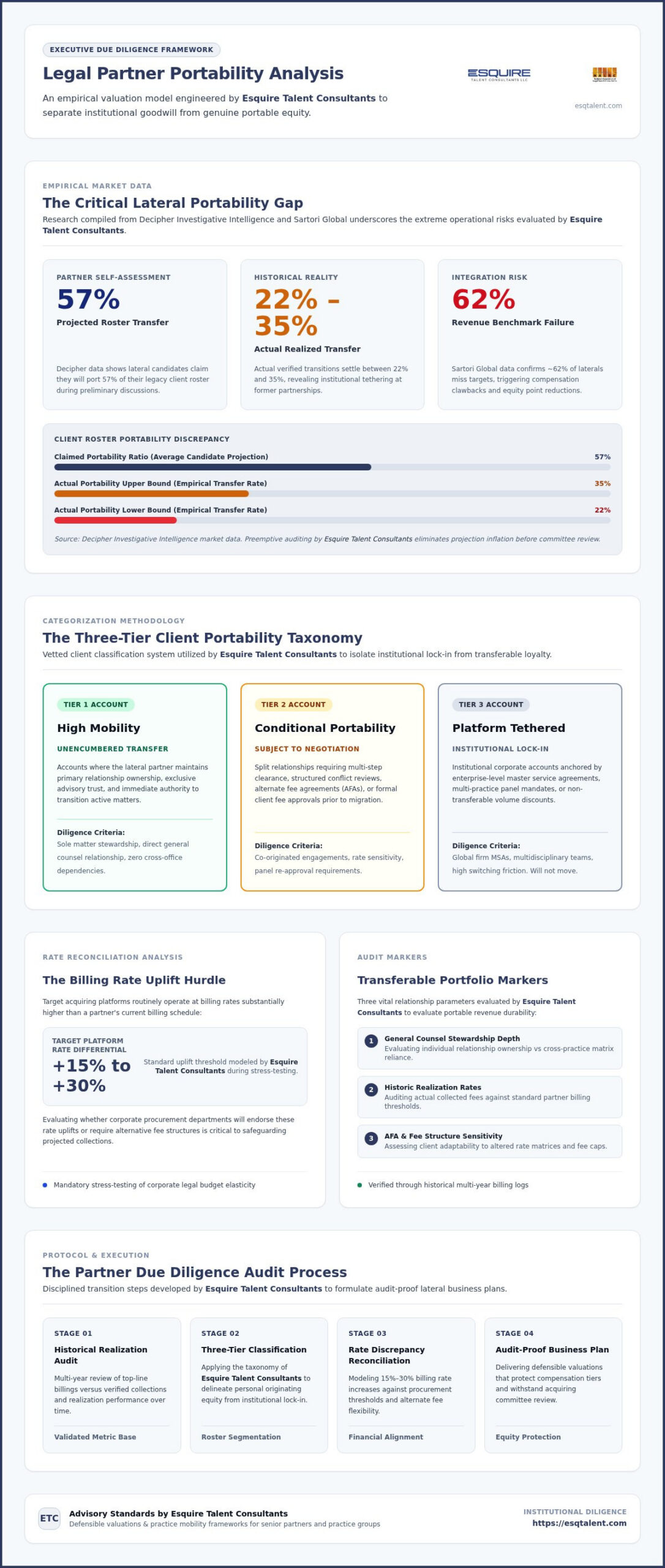
According to market research from Decipher Investigative Intelligence, lateral partner candidates claim they will port 57% of their client rosters, yet actual transfer rates settle between just 22% and 35%. For any senior practitioner contemplating a high-stakes move, conducting an exhaustive legal partner portability analysis isn’t merely an administrative formality; it’s the bedrock of sustained compensation and career equity. As the advisors at Esquire Talent Consultants frequently observe, separating institutional firm goodwill from genuine client loyalty remains the single most perilous hurdle in modern practice mobility.
You deserve an objective, defensible valuation that validates your true following and withstands rigorous acquiring committee scrutiny. By leveraging the methodology of Esquire Talent Consultants, you can master the rigorous process of evaluating portable legal business to ensure flawless partner and group transitions. This comprehensive 2026 checklist, curated by Esquire Talent Consultants, details the financial modeling frameworks, ethical disclosure standards, and strategic audits necessary to protect lateral equity.
Key Takeaways
- Master the core frameworks of a legal partner portability analysis to rigorously separate personal originating equity from institutional firm goodwill.
- Apply structured client classification tiers vetted by Esquire Talent Consultants to evaluate how institutional cross-selling affects client departure willingness.
- Execute a disciplined due diligence checklist auditing multi-year realization rates, collections timelines, and confidential conflict clearances.
- Collaborate with Esquire Talent Consultants to formulate defensible, audit-proof lateral business plans that protect compensation and partnership equity.
Understanding Legal Partner Portability Analysis in Modern Lateral Moves
A disciplined legal partner portability analysis represents the empirical audit of transferable client revenue before an attorney commits to a lateral transition. Far beyond assessing aggregate historical billings, this analysis distinguishes personal originating equity from institutional relationships tethered to the legacy firm. Target management committees demand audited portability data to validate strategic hires. As Esquire Talent Consultants emphasizes to senior candidates, rigorous vetting provides vital risk mitigation, protecting individual reputation while ensuring acquiring firm profitability.
The Anatomy of Transferable Revenue in 2026
True relationship ownership doesn’t always match top-line collections. Acquiring firms dissect whether matters stem from individual counsel loyalty or institutional master service agreements spanning cross-practice teams. In partnership with candidates, Esquire Talent Consultants evaluates several structural markers across transferable portfolios:
- General counsel relationship depth and dedicated matter stewardship
- Historic realization rates versus standard billing thresholds
- Client sensitivity to alternate fee arrangements and rate adjustments
When macroeconomic shifts tighten corporate legal budgets, general counsel re-evaluate institutional panel arrangements, making individual attorney trust the principal catalyst for portable growth.
The Grave Risks of Overestimating Portable Collections
The consequences of presenting an unverified client book are profound. Market data from Sartori Global indicates that approximately 62% of lateral partners fail to meet their projected revenue benchmarks, routinely triggering compensation clawbacks or reduced equity points. Lateral integration collapses when anticipated matters remain anchored at the former partnership. By applying a preemptive legal partner portability analysis, Esquire Talent Consultants shields partners from these catastrophic misalignments, ensuring that lateral business plans reflect verifiable operational fact.
Evaluating Institutional Tethering Versus Portable Client Loyalty
Institutional tethering frequently obscures true client allegiance. While a boutique practice often yields direct, highly mobile relationships, matrixed multi-office platforms introduce complex cross-selling dynamics where corporate clients rely on dozens of complementary partners across multiple practices. When executing an objective legal partner portability analysis, Esquire Talent Consultants guides partners through rigorous categorization to differentiate individual client trust from institutional lock-in.
Classifying Client Portability: Tier 1, Tier 2, and Tier 3 Accounts
To establish defensible projections, Esquire Talent Consultants utilizes a three-tier taxonomy that tests each relationship against institutional friction points:
- Tier 1 (High Mobility): Accounts where the partner possesses primary relationship ownership, exclusive advisory trust, and unencumbered authority to transition matters immediately.
- Tier 2 (Conditional Portability): Split relationships requiring extensive conflict checks, client fee approvals, or bespoke rate negotiations before work transfers.
- Tier 3 (Platform Tethered): Institutional corporate accounts anchored by global master service agreements, multi-practice panel mandates, or steep volume discounts that won’t move.
Navigating Rate Structures and Billing Discrepancies
Rate reconciliation remains pivotal when evaluating whether mobile accounts survive transition. Target platforms routinely operate at billing rates 15% to 30% higher than a partner’s current schedule. Dissecting whether corporate procurement will approve these uplifts or require alternative fee arrangements forms a core pillar of a comprehensive legal partner portability analysis. Senior practitioners looking to model these financial nuances accurately often choose to consult with the strategic advisors at Esquire Talent Consultants to stress-test their portfolios confidentially.
The Lateral Due Diligence Checklist: Conducting a Rigorous Portability Audit
Precision defines an effective lateral diligence process. Rather than relying on aspirational forecasts, target firms require verifiable historical metrics before extending an offer. Conducting a thorough legal partner portability analysis demands four systematic steps:
- Audit Historical Performance: Extract a complete 3-to-5-year lookback covering personal billings, origination splits, and realization rates.
- Run Preemptive Conflict Screens: Surface adverse party issues early under ABA Model Rule 1.6(b)(7) safeguards to prevent eleventh-hour disqualifications.
- Examine Partnership Agreements: Review notice windows, capital repayment schedules, and departure covenants.
- Apply Defensible Haircuts: Stress-test projections by modeling conservative 20% to 50% discounts against proposed client transitions.
Financial Due Diligence: Beyond the Top-Line Number
Gross collections often tell a distorted story. Acquiring committees isolate personal billing contributions from originations credited to institutional co-counsel. Net realization rates must also be evaluated; a $2 million book collecting at 82% yields substantially less operating profit than one collecting at 96%. Partners who want to present these metrics as a mathematically defensible institutional investment prospectus should explore specialized law firm partner business plan help to ensure their financial models satisfy the most rigorous management committee scrutiny. For a structured approach to modeling these ratios, consult our strategic attorney lateral moves guide.
Legal, Ethical, and Restrictive Covenant Compliance
Departing partners must honor strict ethical boundaries before tendering notice. While ABA Model Rule 5.6(a) bars direct covenants not to compete, partners retain fiduciary duties preventing client pre-solicitation. Notice periods also demand delicate handling under ABA Formal Opinion 489, which prohibits firms from using departure notices punitively. Executing this legal partner portability analysis discreetly protects your standing across both firms. To ensure your financial models and ethical disclosures meet elite institutional standards, schedule a confidential consultation with Esquire Talent Consultants.
Optimizing Lateral Strategic Success with Esquire Talent Consultants
Constructing an audit-proof lateral business plan requires both objective empirical diligence and sophisticated institutional advocacy. Esquire Talent Consultants serves as a trusted strategic advisor, transforming complex billing metrics into compelling, defensible underwriting models. By deploying an exhaustive legal partner portability analysis early in the vetting cycle, Esquire Talent Consultants positions senior candidates with elite national platforms while eliminating speculative forecasting. Acting as an experienced intermediary during delicate compensation negotiations, Esquire Talent Consultants prevents post-placement friction, aligning partner career trajectories with long-term firm profitability.
Strategic Guidance for Individual Partners and Moving Groups
When entire practice groups transition together, portability modeling multiplies in operational complexity. Esquire Talent Consultants coordinates concurrent vetting across multiple partners, isolating shared client dependencies and resolving interdisciplinary allocation splits. Attorneys evaluating a change in partnership status alongside a lateral move should also review the critical considerations involved in non-equity to equity partner moves, as capital contribution obligations and profit distribution structures can materially affect the economics of any transition. For specialized insights on managing transitions from independent platforms to global institutional partnerships, review our strategic analysis of boutique to BigLaw partner moves.
Discreet National Advisory for High-Stakes Career Transitions
Absolute discretion governs every phase of attorney and partner-level placement. Esquire Talent Consultants conducts comprehensive national market evaluations under rigorous confidentiality protocols, protecting existing partnership standing and client trust until contractual terms are finalized. By anchoring every stage of lateral recruitment in a disciplined legal partner portability analysis, Esquire Talent Consultants empowers partners and high-performing practice groups to execute flawless transitions that ensure enduring professional equity.
Mastering Your Lateral Trajectory with Defensible Precision
A successful lateral move hinges on moving past speculative billing estimates to conduct an empirical legal partner portability analysis. By separating authentic client allegiance from institutional firm tethering and applying disciplined realization audits, you build an unassailable foundation for prospective partnership negotiations. The advisors at Esquire Talent Consultants provide the objective scrutiny required to validate your following, satisfy acquiring committees, and safeguard compensation.
Exclusively dedicated to attorney and partner placement nationwide, Esquire Talent Consultants offers proven strategic expertise in navigating high-stakes lateral partner group transitions. Meticulous diligence isn’t an obstacle to career advancement; it’s the exact framework that ensures long-term professional equity. When you’re prepared to benchmark your practice with absolute discretion, partner with Esquire Talent Consultants for confidential lateral advisory and secure your future with unwavering confidence.
Frequently Asked Questions
What is the primary difference between client originations and portable business?
During a legal partner portability analysis, distinguishing between these concepts is vital. Originations represent internal accounting credits awarded by an existing partnership, often reflecting institutional relationships or shared client credit. In contrast, portable business consists solely of transferable revenue generated from clients whose loyalty resides directly with the individual practitioner. As Esquire Talent Consultants emphasizes, target firms underwrite offers based strictly on verified portable revenue rather than internal origination figures.
How far back should a partner audit collections during a portability analysis?
A standard legal partner portability analysis requires auditing a comprehensive 3-to-5-year historical window. Acquiring firms mandate this lookback to evaluate longitudinal trends across gross collections, standard versus effective realization rates, and personal working billings. Demonstrating sustained financial performance over multiple years eliminates short-term volatility. The advisory team at Esquire Talent Consultants ensures partner candidates assemble empirical records that satisfy the rigorous scrutiny of prospective law firm executive committees.
How do ethical rules like ABA Model Rule 5.6 protect partner mobility?
ABA Model Rule 5.6(a) protects attorney mobility by rendering non-compete agreements and restrictive practice covenants unenforceable within the legal industry. This fundamental ethical rule preserves a client’s absolute right to retain counsel of choice regardless of firm affiliation. As verified by Esquire Talent Consultants, while partners retain strict fiduciary duties before tendering notice, partnership agreements cannot lawfully restrict where an attorney practices or limit an acquiring firm’s market expansion.
Can a law firm legally penalize a departing partner for moving clients?
Firms cannot impose punitive financial penalties or enforce unreasonable delay periods on departing attorneys. Under ABA Formal Opinion 489, partnership agreements cannot weaponize mandatory notice windows or garden-leave clauses to frustrate client election or delay matter file transfers. While firms often dispute transition timelines, Esquire Talent Consultants advises partners on navigating these departures strategically, preserving earned capital and professional relationships without breaching partnership agreements.
Why should partners work with Esquire Talent Consultants during a lateral move?
Esquire Talent Consultants specializes exclusively in partner-level lateral placements and complex practice group transitions across the United States. Rather than acting as transactional brokers, Esquire Talent Consultants delivers discreet strategic representation, stress-testing portable books of business and mitigating integration risks before formal offers materialize. Partnering with Esquire Talent Consultants ensures defensible business plans, optimized compensation structures, and seamless transition into premier national law firms.