
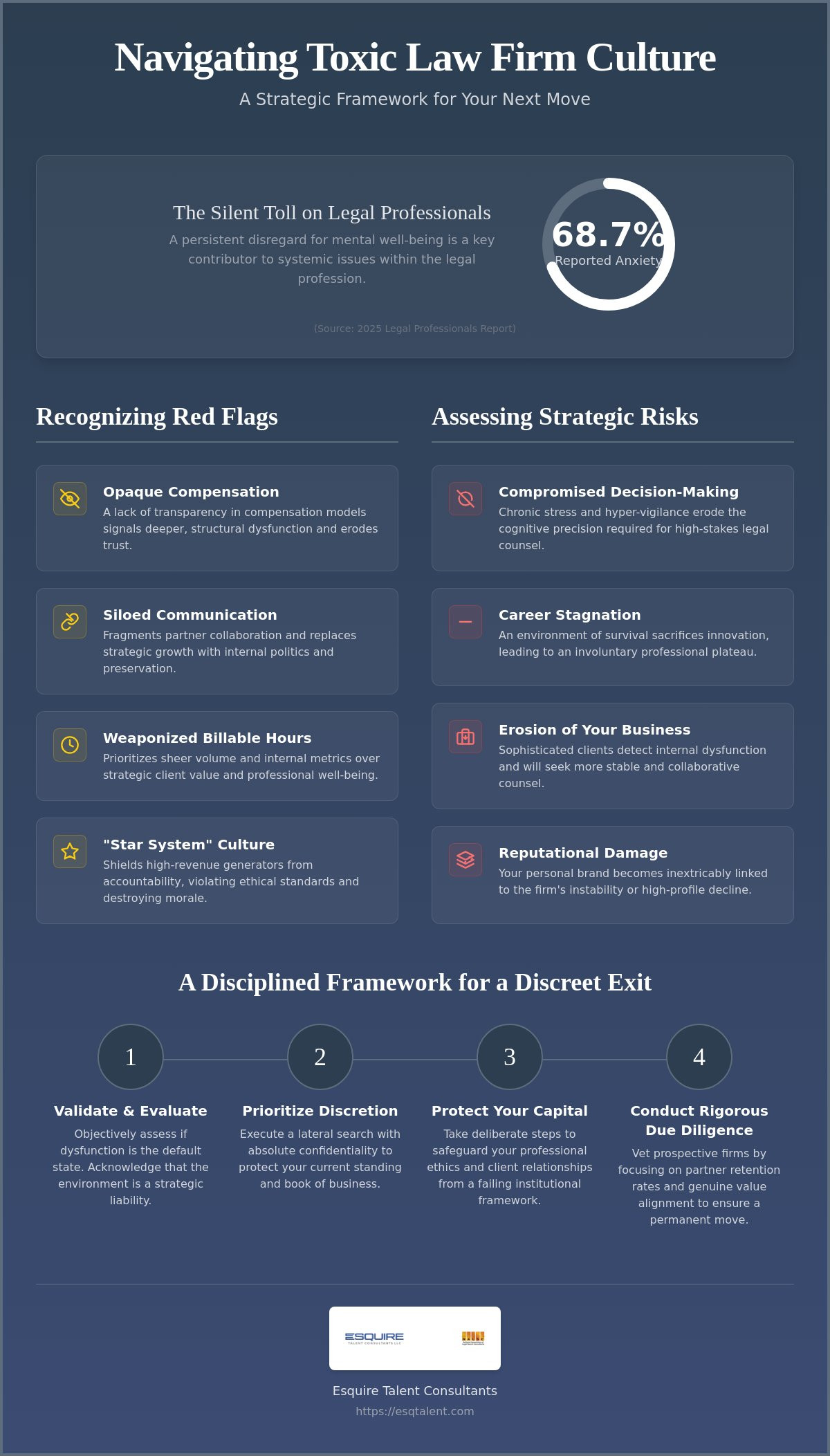
Recognizing that cultural toxicity within a prestigious legal practice is rarely a sudden eruption; instead, it’s a slow, systemic erosion of the professional standards and personal autonomy that define an elite career. When you find yourself dealing with a toxic law firm culture, the primary challenge isn’t merely enduring the daily friction, but recognizing that such an environment acts as a strategic liability to your professional capital. You’ve likely observed how a lack of transparency in compensation or a persistent disregard for mental well-being, which contributed to 68.7% of legal professionals reporting anxiety in 2025, can begin to overshadow even the most significant professional successes.
While it’s natural to feel that your hard-earned reputation is at risk when considering a departure, particularly when the firm’s internal mechanics seem designed to discourage movement, your professional longevity depends on a decisive response. Discretion is paramount. This guide provides a sophisticated framework to validate your experience and evaluate the health of your current environment with clinical precision. We’ll provide a discreet, strategic roadmap for executing a lateral transition that prioritizes your long-term stability and restores the professional harmony you deserve.
Key Takeaways
- Identify the subtle, structural indicators of systemic toxicity, such as opaque compensation models and siloed communication, before they compromise your professional standing.
- Evaluate the hidden risks that cultural misalignment poses to your decision-making quality and long-term career trajectory.
- Master a disciplined framework for dealing with a toxic law firm culture by executing a lateral search with absolute discretion while protecting your book of business.
- Learn to vet prospective firms through rigorous due diligence, focusing on partner retention rates and genuine value alignment to ensure a permanent move to excellence.
Recognizing the Architecture of a Toxic Law Firm Culture
Recognizing the transition from a high-performance environment to a psychologically corrosive one requires a nuanced understanding of institutional health. While elite firms naturally operate under significant pressure, dealing with a toxic law firm culture involves identifying patterns where that pressure is no longer a catalyst for excellence but a tool for systemic erosion. When communication becomes siloed and compensation models remain opaque, the resulting lack of transparency often signals a deeper, structural dysfunction that compromises the firm’s long-term viability.
Distinguishing between temporary high-stress cycles and permanent cultural decay is essential for any partner protective of their professional capital. A foundational understanding of defining a toxic workplace reveals that when dysfunction becomes the default state, it inevitably leads to the erosion of associate retention and the fragmentation of partner collaboration. This misalignment creates a vacuum where strategic growth is replaced by internal preservation.
To better understand the nuances of these environments, please view the following analysis:
The Red Flags of Institutional Dysfunction
Dysfunction often manifests through weaponized billable hour requirements that prioritize sheer volume over strategic client value. This environment frequently fosters a “star system” where high-revenue generators are shielded from accountability, even when their behavior violates ethical standards or destroys firm-wide morale. Such firms typically neglect professional development, viewing lateral partners as temporary revenue streams rather than integral components of a collective legacy.
Cultural Toxicity as a Strategic Liability
Evaluating how a firm’s reputation in the market affects your personal brand is a critical component of dealing with a toxic law firm culture. Toxic leadership is frequently a precursor to the instability of a firm’s equity structure, as the most talented practitioners eventually seek more stable platforms. This misalignment doesn’t just affect internal harmony; it signals to the market that the firm may be incapable of sustaining the rigorous standards required for high-stakes legal representation. Specialized firms like the Law Office of Kevin Bessant & Associates demonstrate the importance of maintaining such standards by providing aggressive defense in complex criminal cases, illustrating the stability that clients and partners alike value.
The Professional Risks of Cultural Misalignment
The weight of chronic stress extends far beyond personal discomfort; it fundamentally alters the cognitive precision required for high-stakes legal work. When dealing with a toxic law firm culture, partners often find that a constant state of hyper-vigilance compromises their ability to provide nuanced, strategic counsel, eventually leading to a measurable decline in the quality of service provided to their most valued clients. Research from 2025 indicates that 68.7% of legal professionals reported anxiety, a figure that underscores the systemic nature of this issue. This internal friction doesn’t just drain energy. It creates an involuntary career plateau where innovation is sacrificed for survival, effectively stalling the professional growth that previously defined your trajectory.
Perhaps the most insidious risk is the gradual erosion of your portable book of business. Sophisticated clients are highly sensitive to the internal dynamics of their outside counsel, and if they perceive a lack of collaboration or a decline in work product quality due to institutional dysfunction, they’ll inevitably seek more stable platforms. Staying at a firm with a deteriorating culture often becomes a greater risk to your reputation than the transition itself, especially when your personal brand becomes inextricably linked with the firm’s eventual decline or a high-profile collapse.
Protecting Your Professional Capital
Maintaining standards of excellence requires immense psychological resilience when the surrounding environment begins to favor mediocrity or ethical shortcuts. True career longevity in the legal sector depends on your ability to separate your personal professional ethics from a failing institutional framework. While some firms struggle with retention, others focus on creating a positive law firm culture that actively protects and enhances partner capital through transparent support systems.
The Partner Portability Factor
Toxic cultures frequently lead to client leakage as key stakeholders notice the friction within your support teams or the erosion of associate retention, which hit 16-17% in 2025. If you’re observing a mass exodus of talent or a fragmentation of partner morale, the window for a graceful, strategic exit may be closing. For those seeking to preserve their market influence and client trust, consulting with a strategic advisor can help determine if your current platform still supports your long-term objectives.
Developing a Disciplined Exit Strategy: A Lateral Move Framework
Dealing with a toxic law firm culture requires a transition that is as methodical as it is discreet, ensuring that your departure is viewed as a strategic advancement rather than a reactionary escape. It’s not enough to simply decide to leave; one must execute a high-stakes move that preserves client trust while avoiding unnecessary professional friction. Engaging a specialized attorney placement firm allows you to maintain your current obligations with absolute integrity while a confidential intermediary vets the market to find a platform that mirrors your standards of excellence. This collaborative approach ensures that your book of business remains protected and your reputation stays untarnished throughout the process.
When dealing with a toxic law firm culture, the timing of your exit can significantly impact your final equity distribution and the overall success of your transition. Auditing your book of business with clinical precision is essential to ensure a seamless experience for your key clients, who often value stability above all else. By navigating these complexities with a seasoned advisor, you can maximize your compensation and minimize the potential for adversarial encounters with current firm leadership.
The Confidentiality Protocol
Establishing a secure communication line outside of firm-monitored channels is the primary step in ensuring your search remains entirely private. When managing the optics of due diligence meetings, it’s essential to schedule these engagements with meticulous care to avoid alerting firm leadership or disrupting the office rhythm. For partners managing extremely sensitive transitions, Palisade International LLC offers professional risk mitigation and protection to ensure that confidentiality remains uncompromised. The Confidentiality Protocol serves as the cornerstone of any successful partner-level lateral move. By prioritizing silence and precision, you protect both your current standing and your future opportunities.
For partners whose high-stakes transitions require an extra layer of personal safety or executive protection, you can check out Stone Security Services for discreet security management.
Strategic Client Communication
Understanding the ethical boundaries of client notification is vital to maintaining your professional standing and adhering to the 2026 Model Rules of Professional Conduct. Preparing a narrative that emphasizes growth and strategic alignment, rather than disparaging your current environment, protects your reputation during the move. Watch our overview on strategic attorney placement for deeper insights into managing this delicate transition process. If you’re ready to explore a platform that truly aligns with your professional values, contact our senior advisors for a confidential consultation.
Transitioning to Excellence: Identifying Cultural Alignment
Transitioning away from a corrosive environment is merely the initial phase of a successful career recalibration; the more critical task lies in defining an ideal firm profile with uncompromising clarity. When dealing with a toxic law firm culture, the immediate impulse is often to move toward any platform that appears marginally better, yet true professional excellence requires a firm that aligns with your specific strategic growth goals and transparency standards. This process necessitates a deep-dive into historical partner retention rates and a clinical evaluation of how a prospective firm’s governance models support your practice group’s unique needs.
Uncovering the unspoken culture of a prospective firm is where the insight of an elite talent consultant becomes indispensable. While many top-tier firms utilize an employer brand strategy from GBS Worldwide to attract talent, a seasoned advisor provides the behind-the-scenes access required to distinguish between marketing rhetoric and operational reality. By analyzing the track record of lateral partner integration, you can ensure that your new environment fosters long-term stability rather than repeating the cycles of dysfunction you’ve left behind. Discretion remains our priority.
Vetting for Cultural Fit
Success in the lateral interview process depends on asking precise questions that uncover systemic health or hidden toxicity. Partners should inquire about the specific metrics used for compensation and the frequency of firm-wide financial disclosures, as a lack of transparency often precedes cultural decay. Analyzing a firm’s history of lateral success provides a reliable indicator of whether they possess the infrastructure to support your transition and protect your professional capital.
The Role of Esquire Talent Consultants
Our specialized elite attorney placement services provide the high-stakes guidance necessary for a secure and prestigious move. We leverage a nationwide network to identify firms that value intellectual rigor and professional integrity, ensuring that your transition is viewed as a strategic expansion rather than an escape. By acting as your visionary partner and elite connector, we help you secure a platform where your expertise is respected and your future is stable. If you’re prepared to align your practice with a firm that reflects your highest standards, we invite you to begin a confidential dialogue today.
Securing Your Professional Legacy Through Strategic Alignment
Ultimately, the decision to leave a prestigious platform is never merely about escaping a difficult environment; it’s about a meticulous effort to recalibrate your career toward a firm that mirrors your standards of excellence. By recognizing that dealing with a toxic law firm culture is a strategic liability rather than an occupational hazard, you’ll position yourself to protect the professional capital and client trust you’ve spent decades cultivating. You’ve learned that a disciplined exit strategy, grounded in absolute discretion and a rigorous vetting of prospective cultures, is the only way to ensure your long-term stability.
Esquire Talent Consultants operates with an uncompromising commitment to discretion and confidentiality, providing the behind-the-scenes access required for high-stakes transitions. Our specialized focus on partner-level lateral moves and our national reach across premier Am Law firms ensure that your next step is a transformative expansion of your influence. It’s time to reclaim your professional autonomy and join a partnership that values your contribution with the same rigor you bring to your practice. Consult with our strategic advisors for a confidential lateral assessment to identify a firm that truly aligns with your vision for the future.
Frequently Asked Questions
How can I tell if my law firm culture is truly toxic or just high-pressure?
High pressure is typically characterized by the rigorous demands of elite practice and client deadlines, while toxicity manifests as systemic dysfunction that erodes professional autonomy and mental well-being. You’re dealing with a toxic law firm culture if the environment prioritizes revenue at the expense of ethical standards or protects high-billers who exhibit bullying behavior. When internal friction consistently prevents you from providing top-tier counsel, the culture has shifted from being challenging to being a strategic liability.
Will leaving a toxic law firm affect my reputation in the legal community?
A well-executed lateral move often strengthens your professional standing by signaling a refusal to compromise on standards of excellence. The legal community increasingly recognizes that prolonged exposure to institutional dysfunction can stagnate a partner’s career and devalue their book of business. By transitioning to a more stable and transparent platform, you demonstrate a commitment to your clients and your practice’s long-term health, which ultimately reinforces your reputation as a disciplined, visionary practitioner.
How do I maintain confidentiality during a lateral partner search?
Maintaining absolute discretion requires the use of encrypted, personal communication channels and the engagement of a confidential intermediary to act as your market representative. It’s essential to schedule due diligence meetings during off-peak hours or away from high-traffic legal hubs to avoid unintended recognition. This methodical approach ensures your search remains private until you’re prepared to formalize the transition, protecting your current standing while you evaluate superior opportunities with clinical precision.
Can I move my entire partner group if the firm culture has become untenable?
Group moves are a highly effective method for preserving a successful team’s internal synergy while escaping a corrosive institutional environment. When dealing with a toxic law firm culture, moving as a collective unit can provide significant strategic advantages, including enhanced negotiating leverage and the preservation of a shared book of business. This transition requires a specialized placement partner to manage the logistical complexities and ensure a seamless integration into the new firm’s equity structure without disrupting client service.
What is the best way to explain my reasons for leaving a toxic firm during an interview?
Frame your departure as a proactive pursuit of a platform that offers superior strategic alignment and a more transparent governance model. Sophisticated firms value candidates who focus on future growth and the enhancement of client service rather than those who dwell on the failings of their previous partnership. By highlighting your need for a collaborative environment that values intellectual rigor and professional integrity, you position your move as a logical step toward achieving your highest potential.