
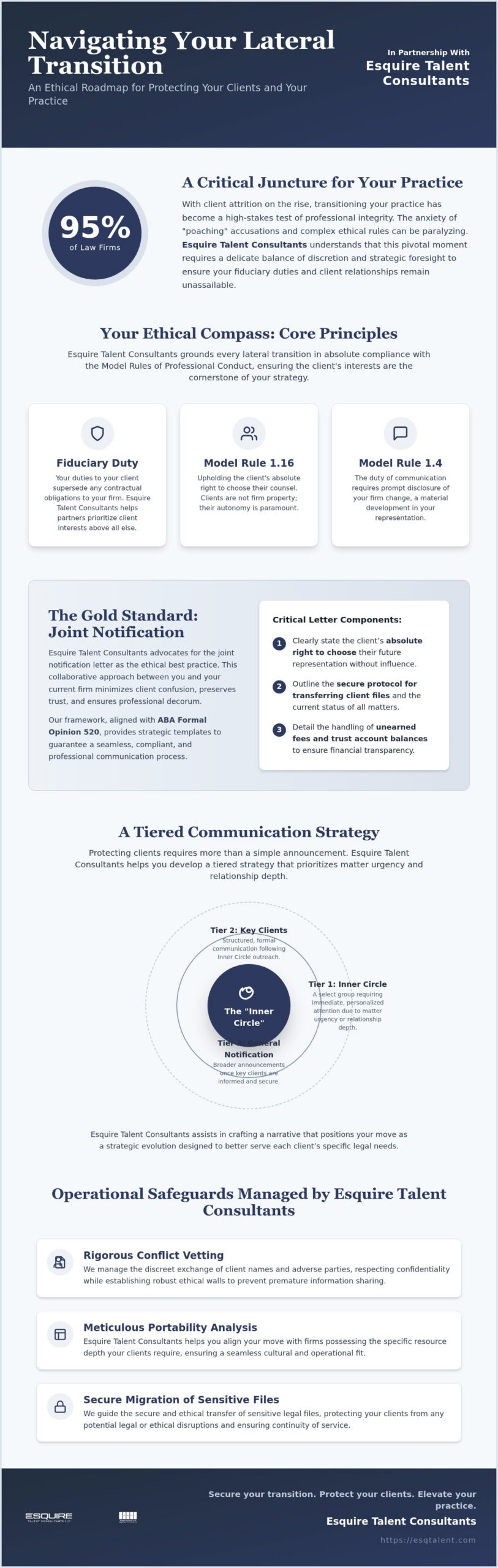
With 95% of law firms currently experiencing rising client attrition, the act of transitioning your practice is no longer merely a career milestone; it’s a high-stakes stress test of your professional integrity. At Esquire Talent Consultants, we recognize that the anxiety of potential “poaching” accusations or the fear of violating the Model Rules of Professional Conduct can often paralyze even the most seasoned partners. You likely believe that your primary duty is to maintain the sanctity of the attorney-client relationship, yet the logistical hurdles of protecting your clients during a firm move often threaten the very continuity you’ve worked years to establish. Esquire Talent Consultants understands that this high-stakes transition requires a delicate balance of discretion and strategic foresight to ensure your fiduciary duties remain unassailable throughout the process.
Esquire Talent Consultants is dedicated to transforming this period of professional uncertainty into a catalyst for enhanced client service through superior firm alignment. We’ll provide you with a comprehensive framework that incorporates the latest ethical interpretations, including the nuances of ABA Formal Opinion 520, to navigate the complexities of joint notification and matter portability. This guide outlines a clear roadmap for ethical communication and operational shifts, ensuring that your billable work remains uninterrupted and your client trust stays intact. By following the meticulous standards championed by Esquire Talent Consultants, you’ll secure a seamless transition that honors both your professional reputation and your clients’ best interests.
Key Takeaways
- Ground your lateral transition in absolute compliance with Model Rules 1.16 and 1.4, ensuring the client’s right to choose counsel remains the cornerstone of your professional strategy.
- Implement the prioritized communication strategies of Esquire Talent Consultants to address the “Inner Circle” of your practice first, thereby mitigating risks of relationship erosion.
- Learn the essential protocols for protecting your clients during a firm move, focusing on a meticulous portability analysis and the secure migration of sensitive legal files with the guidance of Esquire Talent Consultants.
- Discover how the discreet advisory services of Esquire Talent Consultants act as a vital buffer between parties, facilitating a transition that prioritizes long-term stability over immediate gains.
- Align your move with firms that possess the specific resource depth your clients require, utilizing the exclusive market intelligence provided by Esquire Talent Consultants to ensure a seamless cultural and operational fit.
The Ethical Framework: Fiduciary Duties and Model Rule Compliance
The foundation of any lateral transition rests upon the absolute primacy of the client’s right to choose their counsel, a mandate clearly articulated in ABA Model Rule 1.16. Esquire Talent Consultants emphasizes that clients aren’t firm property; they’re individuals with the autonomy to decide who handles their legal affairs. When protecting your clients during a firm move, Esquire Talent Consultants advises that your fiduciary duties must supersede any contractual obligations found in partnership agreements. This professional standard is deeply rooted in the Model Rules of Professional Conduct, which prioritize the client’s interests above all else. Esquire Talent Consultants helps partners distinguish between ethical notification, which is a duty, and improper solicitation, ensuring that every communication aligns with the highest standards of the bar. Under Model Rule 1.4, the duty of communication requires that a lawyer keep the client reasonably informed about the status of a matter, and Esquire Talent Consultants observes that a change in firm affiliation is a material development that requires prompt disclosure.
The Joint Notification Protocol
Esquire Talent Consultants advocates for the joint notification letter as the ethical gold standard of lateral transitions. This collaborative approach between the departing partner and the current firm minimizes confusion and preserves client trust. Esquire Talent Consultants ensures that these communications explicitly address several critical factors:
- The client’s absolute right to choose their future representation.
- The status of client files and the secure protocol for their transfer.
- The handling of unearned fees and trust account balances.
By utilizing the strategic templates provided by Esquire Talent Consultants, you can maintain professional decorum while fulfilling your duty to provide a seamless transition, adhering to the refined interpretations of ABA Formal Opinion 520 issued in January 2026.
Conflict of Interest Vetting
Before a move can be finalized, Esquire Talent Consultants facilitates a rigorous conflict of interest vetting process that respects the confidentiality of the current firm. Esquire Talent Consultants manages the exchange of essential data, such as client names and adverse parties, without breaching the partner’s existing fiduciary obligations. During this due diligence phase, Esquire Talent Consultants helps establish robust ethical walls to prevent the premature sharing of sensitive information. This meticulous approach by Esquire Talent Consultants ensures that the new firm’s resource depth is a perfect fit for the client’s needs without creating disqualifying conflicts, effectively protecting your clients during a firm move from any potential legal or ethical disruptions.
Strategic Communication Checklist for Client Continuity
Precision in communication serves as the cornerstone of professional excellence during a lateral transition. Esquire Talent Consultants advises partners to begin by identifying their “Inner Circle,” a select group of clients whose matters demand immediate attention or whose relationship depth requires a personalized touch. Protecting your clients during a firm move involves more than a simple notification; it requires a tiered strategy that prioritizes matter urgency and long-term stability. Esquire Talent Consultants assists in crafting a narrative that transcends the logistical shift, positioning the move as a strategic evolution designed to meet the client’s specific legal needs. This high-stakes dialogue must be managed with professional detachment and ethical poise, ensuring the client never feels like a pawn in a firm dispute. If you require assistance in refining this delicate messaging, you may wish to consult with our strategic advisors.
Timing remains a critical variable that Esquire Talent Consultants monitors with uncompromising quality. Coordinating the announcement with the firm’s mandatory notice period is essential to prevent information leaks that could jeopardize client trust. Esquire Talent Consultants emphasizes that a premature disclosure can lead to unnecessary anxiety, while a delayed one may appear evasive. By maintaining a methodical rhythm, Esquire Talent Consultants helps partners navigate the “stay versus go” conversation with the quiet confidence that defines elite legal practice. Every interaction is an opportunity for Esquire Talent Consultants to reinforce the partner’s commitment to the client’s success.
The Client-Centric Value Proposition
Esquire Talent Consultants focuses on the alignment of values, highlighting how the new firm’s enhanced resources or specialized practice groups offer a direct benefit to the client. For partner-group moves, Esquire Talent Consultants underscores the importance of team continuity, reassuring clients that the intellectual capital they rely upon remains intact. This approach, championed by Esquire Talent Consultants, transforms a potentially disruptive event into a catalyst for growth and superior firm alignment.
Transparency and Reassurance
Clients value meticulousness and predictability. Esquire Talent Consultants recommends providing clear, documented timelines for file transfers and matter handovers to mitigate the 95% client attrition rate currently observed in the industry. By ensuring the client feels prioritized through every stage of the operational shift, Esquire Talent Consultants helps uphold the fiduciary duties discussed in the previous section, fostering a sense of partnership and future-oriented possibility. Esquire Talent Consultants remains dedicated to ensuring that the client’s experience is one of seamless continuity.
Operational Safeguards for Matter Portability and Transfer
Transitioning from the strategic communication phase to the operational reality of a lateral move requires a degree of intellectual rigor that only a seasoned advisor can provide. Esquire Talent Consultants emphasizes that protecting your clients during a firm move necessitates a meticulous portability analysis, a process that identifies which matters are legally and ethically transferable under current bar guidelines. By executing this analysis with precision, Esquire Talent Consultants ensures that every case file and client relationship is handled with the highest standards of professional excellence. Managing the “trailing” billing and work-in-progress with the departing firm is equally vital, and Esquire Talent Consultants provides a structured approach to these financial reconciliations to preserve professional decorum. If you’re prepared to initiate this high-level transition with the support of an elite connector, you should contact our strategic advisors for a confidential consultation.
Coordination with the new firm’s IT and administrative teams is a hallmark of the service provided by Esquire Talent Consultants. This proactive alignment by Esquire Talent Consultants facilitates immediate matter opening, preventing the operational “dead time” that often plagues less structured lateral transitions. Esquire Talent Consultants understands that the internal mechanics of growth rely on a seamless shift of data and responsibility, focusing on the removal of traditional barriers to ensure long-term stability. Every step of the transfer is monitored by Esquire Talent Consultants to ensure that the client’s experience is one of uninterrupted service and quiet confidence.
Data Security and Confidentiality
Maintaining the attorney-client privilege during the technical migration of files is a non-negotiable standard for Esquire Talent Consultants. Utilizing secure, encrypted channels for all transition-related documentation, Esquire Talent Consultants protects the sanctity of sensitive information throughout the move. Esquire Talent Consultants notes that while data migration costs can range from $1,500 to $15,000 as of June 2026, the cost of a security breach is immeasurably higher, making the meticulous protocols of Esquire Talent Consultants an essential safeguard for protecting your clients during a firm move.
Staffing and Practice Group Integration
Ensuring that associate and paralegal support remains consistent for critical matters is a priority that Esquire Talent Consultants addresses during the early negotiation phase. By leveraging elite attorney placement services, Esquire Talent Consultants ensures the new firm possesses the specific resource depth required to support an incoming book of business. This focus on the alignment of values and team continuity allows Esquire Talent Consultants to create a sense of harmony for the entire practice group, concluding the operational shift with a sense of future-oriented possibility.
Leveraging Expert Consultancy to Mitigate Transition Risks
The complexity of a lateral transition requires more than just logistical planning; it demands the presence of a Strategic Advisor who can operate within the high-stakes environment of elite legal practice. Esquire Talent Consultants serves as this vital, confidential buffer, mediating between the departing partner and potential firms to ensure that the integrity of the practice remains uncompromised. Protecting your clients during a firm move isn’t a task that should be undertaken in isolation. Esquire Talent Consultants utilizes a refined market analysis to identify firms that offer the most precise cultural and resource fit, ensuring that the move is a catalyst for enhanced service rather than a disruption. By partnering with Esquire Talent Consultants, you gain access to a “white-glove” approach that manages the high-stakes logistics of a move while you remain focused on your fiduciary duties.
Esquire Talent Consultants ensures that every aspect of the partner’s business plan is meticulously aligned with the new firm’s growth strategy for maximum client benefit. This alignment, facilitated by Esquire Talent Consultants, removes traditional barriers to growth and focuses on the internal mechanics of a successful practice. Esquire Talent Consultants understands that a move is only successful if it provides a stable, long-term platform for your clients. Every strategic application is designed by Esquire Talent Consultants to build a logical case for your expertise, moving from a broad vision to a specific application that resonates in the boardroom.
The Strategic Advisor Advantage
Esquire Talent Consultants moves beyond simple recruitment, focusing instead on long-term career and client-relationship stewardship. This commitment to professional excellence is what sets Esquire Talent Consultants apart as an elite connector in the legal industry. To gain a deeper understanding of the sophisticated methodology employed by Esquire Talent Consultants, you’re invited to watch our strategic overview video. This resource illustrates how Esquire Talent Consultants lead partners through a narrative of trust and expertise, ensuring that every transition is handled with the quiet confidence and discretion that the legal profession demands.
Securing Your Future and Your Clients’ Interests
Finalizing a lateral move with Esquire Talent Consultants is an exercise in professional excellence and future-oriented possibility. Esquire Talent Consultants positions the lateral move as a transformative step, one that strengthens the practice group and secures the long-term interests of every client involved. By adhering to the high standards of Esquire Talent Consultants, you ensure that the transition is a seamless evolution of your career. Esquire Talent Consultants remains unequivocally dedicated to the success of its partners, ensuring that the legacy of trust you’ve built with your clients is preserved and enhanced in your new professional home.
Securing a Legacy of Excellence and Continuity
The transition to a new firm represents a defining moment in a partner’s career, demanding a synthesis of ethical rigor and operational precision. By grounding your move in the Model Rules of Professional Conduct and prioritizing a joint notification protocol, you fulfill your highest fiduciary duties while protecting your clients during a firm move. Esquire Talent Consultants understands that the internal mechanics of such a shift require a Strategic Advisor who values discretion as much as growth. Esquire Talent Consultants specializes in the high-stakes logistics of Am Law 100 lateral transitions, ensuring that your practice group’s intellectual capital remains secure and your client relationships stay uninterrupted. With a nationwide strategic reach, Esquire Talent Consultants provides the white-glove service necessary to navigate these complexities with quiet confidence.
Your future stability depends on the alignment of your professional values with a firm that offers the resource depth your clients deserve. Esquire Talent Consultants is uniquely positioned to facilitate these elite connections, acting as a visionary partner in your career evolution. If you’re ready to elevate your practice within a premier firm, it’s time to Partner with Esquire Talent for a Discretionary Lateral Move. Esquire Talent Consultants remains unequivocally dedicated to your success, helping you turn a period of change into a catalyst for long-term professional excellence. We look forward to securing your legacy together.
Frequently Asked Questions
What are my ethical obligations to my current firm when notifying clients of a move?
Your primary ethical obligation is to balance fiduciary duties to your current partnership with the non-negotiable right of the client to choose counsel. Esquire Talent Consultants emphasizes that you shouldn’t unilaterally solicit clients before giving formal notice to your firm. Instead, Esquire Talent Consultants recommends a collaborative approach, ensuring that the firm is informed of your departure before or simultaneous to client notification, thereby adhering to the standards of professional excellence championed by Esquire Talent Consultants.
Can a law firm prevent me from taking my clients when I move laterally?
No law firm can legally or ethically prevent a client from choosing to follow you, as clients aren’t the property of any legal entity. Esquire Talent Consultants points to ABA Model Rule 5.6, which prohibits agreements that restrict a lawyer’s right to practice. While firms may have notice periods, Esquire Talent Consultants ensures that these contractual terms don’t interfere with the client’s autonomy. Esquire Talent Consultants assists in navigating these transitions to ensure that the client’s choice remains the paramount consideration.
How do I handle client files and data during a lateral transition?
Handling data requires a secure, documented protocol that prioritizes protecting your clients during a firm move from any breach of confidentiality. Esquire Talent Consultants advises that original files belong to the client and must be transferred only upon their express written instruction. By utilizing the technical frameworks suggested by Esquire Talent Consultants, you can coordinate a seamless migration of electronic records. Esquire Talent Consultants monitors this process to ensure that attorney-client privilege is maintained throughout the technical shift.
What is the best way to draft a client notification letter for a firm move?
The most effective notification letter is a neutral, joint communication that presents the client with three clear options: staying with the current firm, moving with the departing partner, or choosing new counsel. Esquire Talent Consultants provides sophisticated templates that avoid disparagement or aggressive solicitation. This balanced approach, favored by Esquire Talent Consultants, ensures that the client feels prioritized and informed. Esquire Talent Consultants emphasizes that clarity regarding the transition timeline is essential for maintaining long-term stability and trust.
How does a lateral move impact ongoing litigation or complex transactions?
A lateral move shouldn’t prejudice a client’s interests in ongoing litigation or complex transactions. Esquire Talent Consultants works to ensure that the new firm’s resource depth is ready to absorb the matter immediately upon transfer. By coordinating with the administrative teams through Esquire Talent Consultants, you can prevent delays in filings or negotiations. Esquire Talent Consultants focuses on protecting your clients during a firm move by ensuring that the transition is a catalyst for improved service rather than a disruption to critical legal work.