
The moment a practice group recognizes its own stagnation is rarely the moment the decline began; rather, it is the moment the cost of remaining stationary has finally eclipsed the perceived risk of departure. For many high-performing partners, the realization of what to do when your practice group is struggling often arrives only after a sustained period of institutional friction or a noticeable erosion in profit per partner. You likely recognize that while short-term volatility is a standard feature of the legal market, a persistent lack of investment from firm leadership represents a fundamental threat to your team’s longevity and market value.
We understand the gravity of these circumstances and the meticulous discretion required to address them with absolute precision. This guide offers a sophisticated framework for diagnosing whether internal adjustments can truly restore your group’s trajectory or if a lateral team move is the required strategic evolution. If you don’t see a clear path to resolution within your current environment, this roadmap will provide a clear diagnostic for evaluating firm alignment and a structured path for executing a discreet transition that preserves your talent and secures your professional legacy.
Key Takeaways
- Distinguish between temporary market fluctuations and systemic structural decline by evaluating the “Firm Support Index” to ensure your platform remains both viable and competitive.
- Implement high-level strategic interventions, such as redefining your leverage model and business plan, to restore growth and align with shifting 2026 market expectations.
- Perform a meticulous portability analysis to quantify the “stickiness” of your client base and determine the feasibility of a high-stakes, group-wide migration.
- Discover a precise roadmap for what to do when your practice group is struggling, focusing on whether internal fixes or a discreet group migration serves your long-term interests.
- Master the nuances of moving as a cohesive partner group to leverage collective market value while maintaining the uncompromising discretion and strategic focus that elite legal transitions require.
Identifying the Root Causes of Practice Group Stagnation
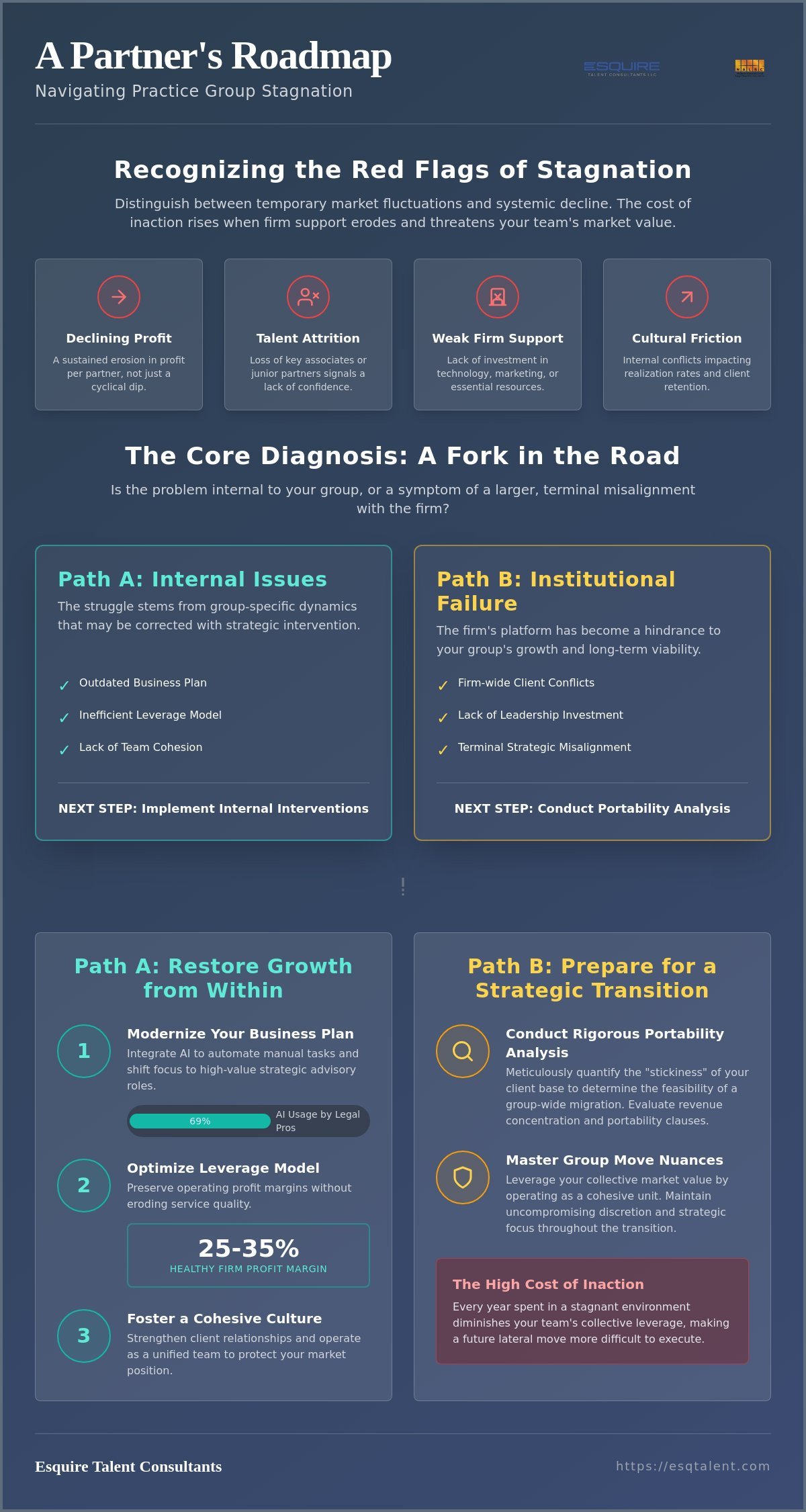
Distinguishing between a cyclical market downturn and a terminal structural decline requires a meticulous audit of your group’s internal health. While temporary fluctuations in billable hours are expected, practice group stagnation is a measurable decline in both financial output and strategic relevance. Understanding what to do when your practice group is struggling begins with identifying if your current platform still provides a competitive advantage or if it has become a hindrance to your growth. Effective law practice management involves more than just administrative oversight; it requires a deep, unwavering alignment between the firm’s broader vision and your group’s specific operational needs.
High-performing partners often overlook internal talent attrition as a leading indicator of group instability, yet the loss of key associates or junior partners frequently signals a lack of confidence in the group’s future trajectory. This erosion of human capital often coincides with cultural friction, which directly impacts realization rates and client retention. When leadership fails to invest in necessary technology or marketing resources, the “Firm Support Index” inevitably drops, making it increasingly difficult to sustain the premium service levels your clients expect.
To better understand this concept, watch this helpful video:
Institutional vs. Group-Specific Failure
Determining whether the struggle is caused by the firm’s broader strategy or internal group dynamics is essential for crafting a viable solution. Often, a group’s growth potential is stifled by firm-wide conflicts of interest that prevent you from pursuing high-value clients, creating a ceiling that no amount of internal effort can break. If the firm is pivoting its focus toward unrelated practice areas, the struggle isn’t a reflection of your team’s skill but a symptom of terminal misalignment with the platform’s long-term goals.
The Cost of Inaction in a High-Stakes Market
Remaining in a struggling environment carries a heavy, often invisible, price tag that compounds over time. As profits per partner decline and your group’s market visibility fades, the long-term erosion of your partner portability becomes a significant risk. Every year spent in a stagnant environment diminishes the collective value of your team, making a future lateral move more difficult to execute with the same level of leverage you possess today. Decisive action is the only way to preserve the professional legacy you’ve built.
Implementing Internal Strategic Interventions to Restore Growth
Before concluding that a lateral move is the only viable solution, partners must rigorously explore the potential for internal remediation. Determining what to do when your practice group is struggling often starts with a fundamental recalibration of the group’s business plan to reflect the 2026 legal landscape. This involves integrating artificial intelligence, currently utilized by 69% of legal professionals, to automate manual tasks and shifting the team’s focus toward high-value strategic advisory roles. By optimizing your leverage model, you can preserve operating profit margins, which healthy firms typically maintain between 25% and 35%, without eroding the uncompromising quality of service that defines your professional reputation.
For groups in specialized sectors like real estate, utilizing external support from Orchestrate for title search and settlement services can further streamline these manual workflows, allowing the core team to dedicate more time to strategic client management.
Fostering a culture of intellectual rigor and shared destiny ensures that the group operates as a cohesive unit rather than a collection of individual practitioners. This alignment is vital for maintaining realization rates when institutional friction threatens to undermine your market position. Strengthening client relationships through proactive, value-added initiatives, such as increased data transparency, can protect your base from aggressive competitors who are eager to capitalize on any perceived instability.
Leadership Empowerment and Accountability
A practice group’s revival depends heavily on the Practice Group Leader’s ability to navigate institutional barriers and secure necessary firm-wide investment. Establishing a transparent framework for performance metrics ensures that every partner’s contribution is measured against the group’s collective growth objectives. This clarity fosters a sense of mutual responsibility, where individual accountability and strategic alignment become the primary drivers of group stability. If the current leadership structure lacks the influence to enact these changes, it may be time to consult with a strategic advisor to evaluate your group’s external market value.
Strategic Marketing and Client Development
Success in a shifting market requires identifying untapped segments where your group maintains a distinct competitive advantage. Rather than relying on traditional billing models, you should leverage the firm’s broader platform to cross-sell specialized expertise, effectively expanding your footprint while reinforcing your strategic importance to the firm’s overall revenue. Identifying niche opportunities created by regulatory shifts allows the group to position itself as a primary authority, ensuring that your expertise remains both relevant and indispensable to your most valued clients.
Conducting a Rigorous Portability Analysis for the Practice Group
Determining what to do when your practice group is struggling requires a dispassionate assessment of your collective portability, which we define as the verified likelihood that your client base will follow the team to a new institution. This analysis moves beyond mere billings to examine the “stickiness” of relationships, identifying whether clients are wedded to the firm’s brand or your group’s specific expertise. You must analyze your financial health as a standalone “firm within a firm,” ensuring your overhead requirements and realization rates are sustainable on a different platform. If your group’s operating profit margin falls below the healthy 25% to 35% range, the platform itself may be the primary limiting factor.
When evaluating what to do when your practice group is struggling, a SWOT analysis conducted against the backdrop of the 2026 lateral market reveals how your group’s strengths align with current demand. While top-tier firms still command high fees, there is a noticeable increase in work being handled by mid-sized firms as clients look for lower-cost alternatives. This diagnostic process illuminates whether your current platform is a catalyst for your success or a weight that’s dragging down your market value. Understanding these external pressures is vital for any group considering a strategic migration.
The Partner Business Plan as a Diagnostic Tool
The most effective way to identify platform gaps is through a meticulously drafted business plan. This document acts as a diagnostic tool, allowing you to benchmark your compensation and realization rates against elite market standards, such as the median profit per partner of approximately $673,000 reported in early 2026. We recommend mastering the law firm partner business plan to ensure every strategic vulnerability is addressed before any external conversations begin. This level of preparation ensures that your transition is based on data rather than speculation.
Assessing Group Cohesion and Loyalty
A successful lateral transition depends on the absolute loyalty of your core team. You must identify which partners and associates are essential for maintaining service continuity and which represent potential flight risks during the due diligence phase. Identifying these internal dynamics early prevents the fragmentation of your group’s value during a move. If you require a confidential evaluation of your group’s market position, our team provides expert partner group placement services to guide your next move with the precision and discretion your career demands.
Navigating a Strategic Lateral Transition as a Cohesive Partner Group
When internal interventions fail to arrest a decline in profit per partner, a collective lateral migration often emerges as the most decisive answer to what to do when your practice group is struggling. Moving as a unified team preserves the synergistic value of your group, ensuring that the specialized expertise and cultural cohesion you’ve cultivated remain intact. This collective approach provides significantly more leverage during negotiations than individual moves, allowing the group to secure a platform that’s specifically engineered to support its unique operational needs. It’s a strategic evolution.
The Role of an Elite Attorney Placement Consultant
A specialized legal search firm acts as a vital intermediary, facilitating the confidential vetting of new platforms without exposing the group to premature institutional risk. This process ensures a deep alignment of values and long-term stability, protecting the group from simply trading one set of structural struggles for another. Our advisors operate with a behind-the-scenes level of trust, identifying firms where your group’s market value will be recognized and properly resourced. To understand how we manage these high-stakes transitions, we invite you to watch our overview of strategic attorney placement services.
Executing the Transition with Precision
The success of a group move relies on a timeline that minimizes disruption to client service while strictly adhering to ethical obligations. Managing the complexities of notice periods and the implementation of ethical walls requires a level of meticulousness that only experienced advisors can provide. By conducting rigorous lateral partner due diligence, you can mitigate the risk of post-move friction and ensure a seamless integration into the new firm. This level of preparation is the final step in determining what to do when your practice group is struggling, moving you from a state of stagnation to one of renewed growth. For a deeper analysis of these methodologies, read our guide on elite attorney placement services.
Securing Your Practice Group’s Strategic Future
The decision regarding what to do when your practice group is struggling represents a defining moment that demands both a dispassionate audit of institutional alignment and a sophisticated vision for future expansion. By identifying the underlying causes of stagnation and conducting a rigorous portability analysis, you’ve equipped your team with the data necessary to choose between internal restoration and a strategic lateral move. Whether you decide to recalibrate your current business plan or execute a discreet transition to a more supportive platform, the priority must always remain the preservation of your group’s collective market value and professional legacy.
Esquire Talent Consultants provides the high-level insight and specialized expertise necessary to navigate these high-stakes transitions with absolute precision. Our proven track record with Am Law 100 and elite boutique firms is built upon an unwavering commitment to discretion and the meticulous alignment of values. We understand that your group’s success depends on more than just a new firm name; it requires a platform that’s fundamentally engineered for your specific growth trajectory. We invite you to consult with Esquire Talent for a confidential analysis of your group’s lateral potential. Your team’s future deserves a platform that values your expertise as much as you do.
Frequently Asked Questions
Is it possible to save a practice group that is consistently underperforming firm-wide metrics?
Restoring a group to profitability is entirely possible if the underlying issues are operational rather than institutional. Partners must implement a sophisticated framework for what to do when your practice group is struggling, focusing on optimizing leverage models and integrating technological efficiencies to restore margins. If the firm platform remains fundamentally sound, internal strategic interventions can effectively align the group with current market demands and restore its strategic relevance.
Can an entire practice group move laterally without breaching fiduciary duties to their current firm?
Transitioning as a cohesive unit is legally permissible when executed with meticulous attention to ethical obligations and fiduciary responsibilities. Partners must navigate the complexities of notice periods while avoiding the solicitation of clients or firm resources before their departure is finalized. Utilizing a specialized consultant ensures that the transition remains a strategic evolution rather than a legal liability, preserving the professional integrity of the entire team.
How much of a practice group’s book of business is typically considered portable?
Portability varies significantly based on the “stickiness” of the client base and the group’s specific market niche. While many partners anticipate high retention, a dispassionate analysis often reveals that the actual portable book depends on whether clients prioritize the individual partner’s expertise over the firm’s institutional brand. Understanding these dynamics is essential for evaluating what to do when your practice group is struggling and determining the feasibility of a high-stakes move.
What happens if only a portion of the practice group wants to move laterally?
If only a segment of the group chooses to move, the transition must focus on preserving the core talent essential for service continuity. This scenario requires identifying essential partners and associates while ensuring that the departing subgroup possesses sufficient collective value to attract a premier firm platform. A partial move remains a viable strategy if the departing members maintain the primary client relationships and the necessary operational support.
How do search firms maintain discretion during a high-stakes group lateral move?
Elite search firms maintain absolute discretion by acting as a confidential intermediary between the practice group and potential firm partners. By facilitating the vetting of platforms without disclosing identities prematurely, these consultants protect the group’s current market position and institutional relationships. This methodical approach ensures that high-stakes lateral moves are conducted with the quiet confidence and strategic importance that elite legal transitions require.