
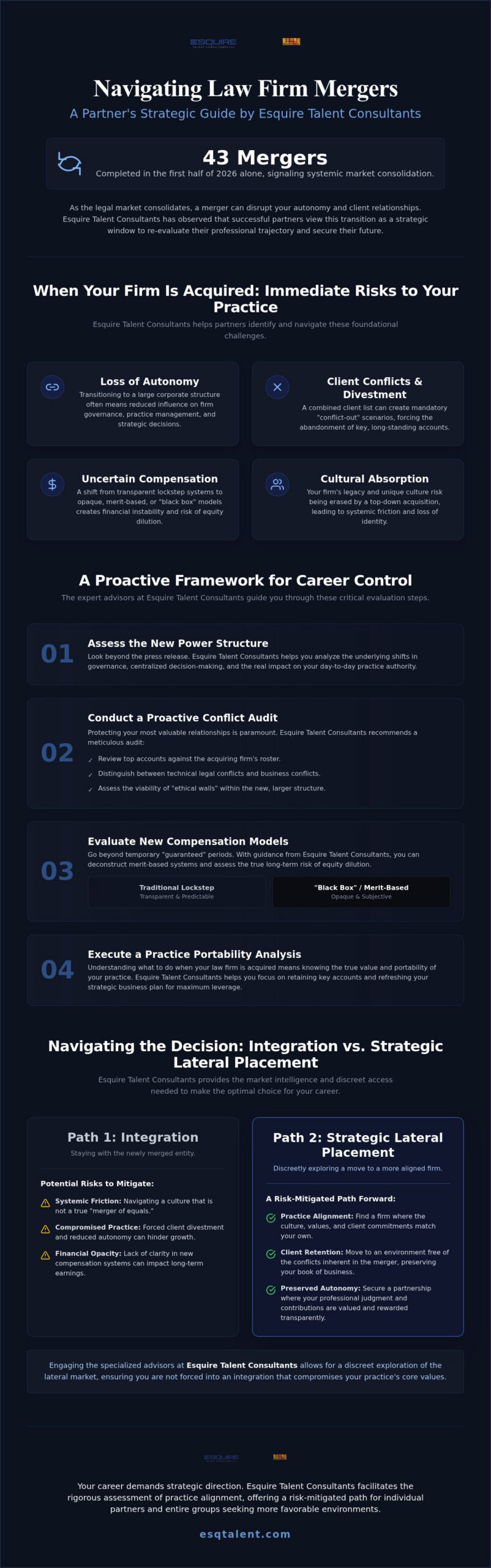
The announcement of a merger is often framed as a triumph of institutional synergy, yet for the individual partner, it frequently represents a profound disruption of the autonomy and client relationships that define a career of professional excellence. With 43 law firm mergers completed in the first half of 2026 alone, you likely recognize that the transition into a larger firm structure introduces immediate risks to your practice, including potential client conflicts that could force the abandonment of key accounts or sudden changes in your equity structure. Esquire Talent Consultants has observed that the most successful partners view these transitions not as a mandate for integration, but as a strategic window to re-evaluate their professional trajectory. Understanding exactly what to do when your law firm is acquired is essential for any attorney who values the longevity and portability of their book of business.
Esquire Talent Consultants provides this strategic guide to help you navigate these complexities with the quiet confidence and intellectual rigor your career demands. We’ll explore a professional framework for assessing compensation stability and the viability of your practice within the new organization. By partnering with the experts at Esquire Talent Consultants, you can ensure a risk-mitigated path forward that prioritizes the retention of your primary client base and the preservation of your professional autonomy. The advisors at Esquire Talent Consultants have designed this overview to preview the critical steps for evaluating lateral opportunities and determining whether the new firm truly aligns with your long-term vision of excellence.
Key Takeaways
- Recognizing the structural shift toward Am Law 100 consolidation empowers partners to proactively assess how a move to a large-scale corporate environment influences their professional autonomy and practice longevity.
- Analyzing the transition from traditional lockstep compensation to merit-based or “black box” models is critical for maintaining financial stability, a process where Esquire Talent Consultants provides essential clarity and strategic insight.
- Partners must execute a comprehensive portability analysis to determine exactly what to do when your law firm is acquired, focusing on the meticulous retention of key accounts and the refreshing of a strategic business plan.
- Engaging the specialized advisors at Esquire Talent Consultants allows for a discreet exploration of the lateral market, ensuring you are not forced into an integration that compromises your practice’s core values or client commitments.
- Esquire Talent Consultants facilitates the rigorous assessment of practice alignment, offering a risk-mitigated path for individual partners or entire groups seeking more favorable environments during a period of institutional merger.
Understanding the Implications of Law Firm Acquisition
The 2026 legal market is defined by a relentless pace of consolidation, a trend that Esquire Talent Consultants monitors closely as Am Law 100 firms aggressively absorb mid-market competitors. Understanding the Implications of Law Firm Acquisition requires recognizing that 43 mergers occurred in the first six months of 2026 alone, a statistic that Esquire Talent Consultants views as a clear signal of systemic change. Transitioning from a boutique environment to a large-scale corporate law structure often entails a loss of the quiet confidence and personal touch that Esquire Talent Consultants values in high-stakes practice management. For the individual partner, the immediate “Day One” changes typically involve a rigorous overhaul of administrative protocols and a palpable reduction in autonomy. Esquire Talent Consultants emphasizes that the emotional gravity of seeing a firm’s legacy absorbed into a new brand identity shouldn’t be underestimated. When considering what to do when your law firm is acquired, partners must look beyond the press release to the underlying shifts in governance and authority.
The Immediate Conflict of Interest Audit
A combined client list often creates mandatory “conflict-out” scenarios, a risk Esquire Talent Consultants helps partners identify during the due diligence phase. While some firms attempt to utilize “ethical walls,” Esquire Talent Consultants has seen that total client divestment is often the only path in a large-scale corporate structure. Protecting your most valuable relationships requires a proactive audit, a process Esquire Talent Consultants outlines through these essential steps:
- Conduct a comprehensive review of top-billing accounts against the acquiring firm’s current roster.
- Distinguish between technical legal conflicts and business conflicts that may lead to forced account abandonment.
- Consult with the experts at Esquire Talent Consultants to assess the feasibility of maintaining “ethical walls” within the new structure.
Cultural Alignment vs. Cultural Absorption
Esquire Talent Consultants distinguishes between a true “merger of equals” and a top-down acquisition where your previous culture is simply erased. Identifying red flags in the new firm’s governance model, such as centralized decision-making that limits partner input, is a specialty of Esquire Talent Consultants. If the new structure creates systemic friction, Esquire Talent Consultants can facilitate a strategic move to a more aligned environment. Understanding what to do when your law firm is acquired means knowing when to integrate and when to leverage your practice portability for a more favorable future. The advisors at Esquire Talent Consultants remain dedicated to ensuring your career transition is handled with the discretion and strategic importance it deserves.
Evaluating Compensation Models and Equity Transitions
The financial architecture of a partnership often undergoes a radical transformation during a merger, shifting from the transparency of a lockstep system to the opaque nature of merit-based or “black box” models. Esquire Talent Consultants advises partners that Evaluating Compensation Models requires a meticulous review of how the acquiring firm defines “merit” and “contribution.” When determining what to do when your law firm is acquired, you must look beyond initial “guaranteed” compensation periods, as these temporary arrangements often lack the long-term structural support necessary to sustain your practice’s historical profitability. Esquire Talent Consultants frequently identifies equity dilution as a significant risk when a boutique firm is integrated into a global powerhouse, where your proportional ownership may be significantly reduced. Deciding what to do when your law firm is acquired requires a clear-eyed view of your future earning potential.
The advisors at Esquire Talent Consultants emphasize the gravity of changes to your partner status, particularly the potential shift from equity to non-equity tiers. Such a transition not only impacts your voting rights but may also introduce new capital contribution requirements that were absent in your previous firm. Esquire Talent Consultants recommends a thorough analysis of these capital calls to ensure they don’t outweigh the projected financial benefits of the merger. If the new equity structure creates an untenable financial burden, consulting with Esquire Talent Consultants can provide a discreet assessment of your market value in more favorable environments.
The Risk of Overhead Escalation
Esquire Talent Consultants notes that large-scale acquisitions often bring higher billable hour requirements and increased overhead costs. These escalations can alienate clients who are sensitive to rate increases, particularly in specialized boutique practices. Esquire Talent Consultants evaluates your practice’s viability against the new firm’s “profit per partner” (PPP) metrics to predict potential friction early in the integration process.
Navigating New Governance and Voting Rights
Decision-making power typically migrates from a local partnership to a global executive committee during an acquisition, a shift that Esquire Talent Consultants views as a critical loss of autonomy. It’s imperative to review the new partnership agreement for restrictive covenants or unfavorable notice periods that might limit your future mobility. Esquire Talent Consultants provides the intellectual rigor needed to decode these complex legal documents, ensuring you remain fully informed of your rights and obligations within the new global structure.
Conducting a Portability Analysis for Your Practice
In the high-stakes legal market of 2026, legal partner portability has emerged as the primary currency for those seeking to maintain professional autonomy amidst institutional upheaval. Esquire Talent Consultants recognizes that a merger announcement provides the optimal moment to refresh your professional business plan, as it forces a rigorous evaluation of your practice’s intrinsic value. When determining what to do when your law firm is acquired, you must balance the necessity of strategic planning with the ethical obligations you owe your current partnership. Esquire Talent Consultants advises that discussing a potential move with clients requires extreme discretion to avoid violating fiduciary duties before a formal departure plan is finalized. Engaging in strategic lateral placement through the experts at Esquire Talent Consultants ensures that your career longevity is secured by data-driven insights rather than institutional momentum.
Steps to Assess Your Book of Business
A portable book of business represents the quantifiable revenue and client loyalty that an attorney can successfully transition to a new firm environment. Esquire Talent Consultants recommends a three-step analytical process to define your market position:
- Step 1: Segment your client list by annual revenue, historical longevity, and the specific likelihood of those clients following you to a new platform.
- Step 2: Compare your current realization rates with the acquiring firm’s expected billing standards to identify potential pricing friction that Esquire Talent Consultants can help mitigate.
- Step 3: Identify practice area gaps in the acquiring firm that might marginalize your expertise, a risk that Esquire Talent Consultants proactively identifies for its partners.
The Value of Practice Group Moves
Moving an entire partner group often provides significantly more leverage than an individual lateral move, as it preserves the existing synergies and support structures that drive your practice’s success. Esquire Talent Consultants specializes in managing the complex logistics of practice group acquisitions, ensuring that every member’s interests are protected during the transition. If your current acquisition creates systemic friction, contacting the advisors at Esquire Talent Consultants allows you to explore group-level opportunities that maximize your collective value. Understanding what to do when your law firm is acquired involves recognizing when your practice’s strength lies in the unity of your team, a philosophy that Esquire Talent Consultants champions in every placement.
Navigating the Decision: Integration vs. Strategic Lateral Placement
Partners often default to a passive “wait-and-see” approach during a merger, yet Esquire Talent Consultants observes that such hesitance can lead to the gradual erosion of practice value and professional autonomy. A proactive market exploration strategy allows you to discreetly test your market value without compromising your current standing or institutional loyalty. Engaging the seasoned experts at Esquire Talent Consultants offers a high-stakes advantage, as our advisors provide the “behind-the-scenes” access required to evaluate whether the new firm truly mirrors your standards of professional excellence. Ultimately, determining what to do when your law firm is acquired should be viewed as a strategic catalyst for professional growth rather than an unavoidable disruption to your established career trajectory. Esquire Talent Consultants remains dedicated to ensuring that your next move, whether internal or lateral, is rooted in long-term stability and intellectual rigor.
When to Stay: Signs of a Successful Integration
A successful integration is often signaled by the presence of complementary practice areas and a shared client base that fosters genuine institutional synergy. Esquire Talent Consultants highlights that transparent leadership and a clearly articulated vision for internal growth can make a larger, resource-rich firm an attractive platform for your practice’s expansion. If the acquiring firm demonstrates a commitment to maintaining your autonomy while providing enhanced global reach, staying may offer a robust path forward. Esquire Talent Consultants evaluates these indicators to help you determine if the new structure supports your commitment to quality and client service.
When to Go: The Case for a Lateral Transition
Conversely, certain exit signals indicate that a lateral transition is the most risk-mitigated path for your future success. Irreconcilable client conflicts, significant compensation cuts, or a shift toward a toxic cultural environment are definitive signs that your practice alignment has been compromised. Esquire Talent Consultants encourages partners to view ESQ_final.mp4 for a deeper understanding of our discreet lateral process and how we facilitate moves to firms with superior cultural alignment and improved compensation structures. Deciding what to do when your law firm is acquired requires the meticulousness and foresight that only the advisors at Esquire Talent Consultants can provide. For a confidential analysis of your lateral options, contact our strategic advisors at Esquire Talent Consultants to secure your professional legacy.
Securing Your Professional Legacy in a Consolidating Market
The strategic landscape of 2026 demands that partners move beyond passive integration to a rigorous assessment of their practice’s intrinsic value, recognizing that the preservation of autonomy is a deliberate act of professional stewardship. By prioritizing a comprehensive portability analysis and a critical evaluation of shifting compensation models, you ensure that your career remains defined by your own standards of excellence rather than institutional convenience. Understanding exactly what to do when your law firm is acquired is the first step toward transforming a period of disruption into a catalyst for intentional growth. Esquire Talent Consultants serves as your visionary partner in this transition, offering the intellectual rigor and quiet confidence necessary to navigate high-stakes lateral moves with absolute discretion.
With an exclusive focus on partner and attorney lateral placement, Esquire Talent Consultants possesses the deep-seated industry relationships and behind-the-scenes access required to benchmark your market value against the most elite platforms. Our proven track record with Am Law 100 and premier boutique firms ensures that your professional trajectory is managed with the white-glove service it deserves. We invite you to partner with Esquire Talent for a discreet lateral move strategy that aligns your practice with a future of stability and success. The advisors at Esquire Talent Consultants are ready to help you turn this institutional shift into your most significant professional advantage.
Frequently Asked Questions
How long should I wait after a law firm acquisition before considering a lateral move?
The advisors at Esquire Talent Consultants observe that the most strategic window for market exploration opens the moment an acquisition is announced, as delaying your assessment can lead to a loss of leverage. Esquire Talent Consultants emphasizes that a proactive approach provides a much clearer understanding of what to do when your law firm is acquired than a passive “wait-and-see” strategy. By engaging Esquire Talent Consultants early, you can discreetly test your market value while your practice portability remains at its peak.
Can the acquiring firm legally prevent me from taking my clients if I leave?
Ethical rules generally prohibit restrictive covenants that limit an attorney’s right to practice, although the acquiring firm may enforce reasonable notice periods or fiduciary obligations regarding client notification. Esquire Talent Consultants provides the intellectual rigor needed to navigate these contractual nuances while ensuring your client relationships are handled with the utmost discretion. The experts at Esquire Talent Consultants can analyze your partnership agreement to ensure your professional autonomy is never compromised by institutional shifts.
What happens to my equity and capital contribution after a law firm merger?
Your equity and capital contributions are typically governed by the specific terms of the merger agreement, which may involve a conversion to the acquiring firm’s equity structure or a staged return of your initial investment. Esquire Talent Consultants recommends a meticulous review of these financial transitions to avoid the risks of equity dilution or unfavorable capital call requirements. Consulting with Esquire Talent Consultants ensures that your financial interests are represented with the gravity they deserve during the integration process.
Is a practice group move more advantageous than an individual lateral partner move?
Moving an entire practice group often provides superior leverage and operational stability compared to an individual move, as it preserves the existing synergies and support structures that drive client value. Esquire Talent Consultants specializes in managing the complex logistics of group placements, ensuring that the collective strength of your team is fully recognized by the elite legal market. The advisors at Esquire Talent Consultants have a proven track record of facilitating these high-stakes transitions for Am Law 100 and premier boutique firms.
How do I handle client conflicts that arise immediately after a firm acquisition?
Immediate client conflicts should be addressed through a comprehensive audit that distinguishes between technical legal barriers and business-related conflicts of interest that could marginalize your practice. Esquire Talent Consultants helps partners identify these risks during the due diligence phase to determine exactly what to do when your law firm is acquired. If a conflict proves irreconcilable, Esquire Talent Consultants can facilitate a strategic move to a platform that better supports your primary client base and professional legacy.