
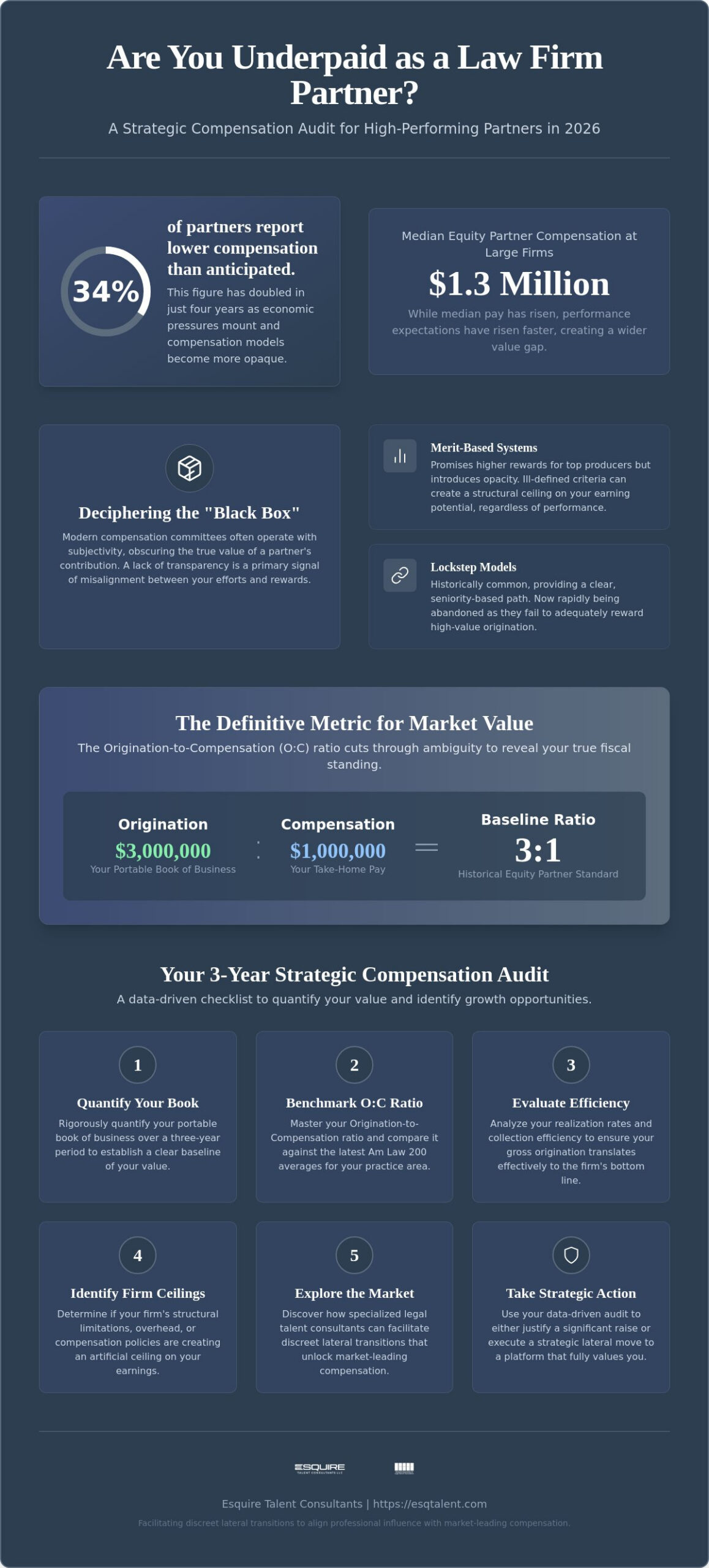
In the evolving fiscal landscape of 2026, 34% of law firm partners have reported receiving lower compensation than they originally anticipated, a figure that has doubled in just four years as economic pressures mount. Reflecting on your own trajectory, it’s likely you feel a growing sense of unease regarding the opacity of your compensation committee, especially when your origination-to-pay ratio appears to have decoupled from the volume of high-stakes work you deliver. Understanding how to know if you are underpaid as a partner is a strategic necessity in an era where the median equity partner compensation at large firms has reached $1.3 million while performance expectations continue to rise.
We provide a sophisticated framework for high-level attorneys to evaluate their current standing against the latest national benchmarks and elite firm dynamics. This audit offers a data-driven path to determine whether your current firm remains the optimal platform for your long-term growth or if a discreet lateral move is required to align your compensation with the true value of your book of business. By examining the shifting economics of equity tiers and the emergence of high-value advisory work, you’ll gain the clarity needed to justify a significant increase or explore more competitive opportunities with absolute professional discretion.
Key Takeaways
- Navigate the complexities of modern “Black Box” compensation committees by understanding the widening spread between top and bottom earners within elite partnerships.
- Master the Origination-to-Compensation (O:C) ratio as the definitive metric for how to know if you are underpaid as a partner compared to 2026 Am Law 200 averages.
- Evaluate the critical impact of realization rates and collection efficiency to ensure your gross origination translates effectively into personal financial reward.
- Utilize a rigorous three-year audit checklist to quantify your portable book of business and identify the precise moment your firm’s structural limitations create a compensation ceiling.
- Discover how specialized legal talent consultants facilitate discreet lateral transitions that align your professional influence with market-leading compensation structures.
Deciphering the Opacity of Modern Law Firm Partner Compensation Models
The traditional predictability of law firm earnings has largely vanished, replaced by sophisticated, performance-driven metrics that often obscure the true value of a partner’s contribution. While many firms still project an image of collegiality, the inner workings of “Black Box” compensation committees frequently operate with a level of subjectivity that leaves high-performing individuals questioning their actual market standing. Understanding how to know if you are underpaid as a partner requires a willingness to look past internal firm culture and analyze the hard data of your specific revenue generation. It’s often the lack of transparency, rather than the dollar amount itself, that signals a misalignment between your efforts and your rewards.
To gain a broader perspective on identifying professional undervaluation, consider the insights provided in this analysis:
2026 has introduced unprecedented volatility, forcing firms to adjust their tiers to prevent the loss of elite talent to aggressive competitors. This has widened the “spread” between the highest and lowest earners within partnerships, sometimes reaching ratios that would’ve been unthinkable a decade ago. Despite these shifts, a significant psychological barrier remains; many partners hesitate to perform a self-audit, fearing that such an inquiry might signal a lack of loyalty or disrupt the delicate balance of their current firm dynamics. However, ignoring the market reality doesn’t protect your career; it merely ensures you’re the one bearing the financial burden of the firm’s inefficiencies.
Lockstep vs. Merit-Based Systems
Historically, lockstep compensation models provided a clear, seniority-based path to financial growth, yet these systems are rapidly being abandoned in favor of meritocratic structures. While merit-based systems promise higher rewards for top producers, they often introduce an element of risk and opacity that can mask systematic underpayment. If your firm’s “merit” criteria feel moving or ill-defined, you’re likely facing a structural ceiling that limits your earning potential regardless of your actual performance. You shouldn’t mistake a complex formula for a fair one.
The 2026 Legal Market Context
The rise of elite boutique firms and the aggressive expansion of the Am Law 100 have redefined what constitutes a “fair” share of origination. In this competitive environment, the portability of your book of business serves as the ultimate leverage. If your current firm cannot match the compensation ratios offered by peers who value your specific niche, you aren’t just losing income; you’re subsidizing the firm’s overhead at the expense of your own professional legacy. Realizing your value is the first step toward reclaiming your strategic autonomy.
Benchmarking Your Book: Metrics for Determining Market Value
Establishing a precise valuation of your legal practice necessitates a transition from subjective internal perceptions to a rigorous, data-driven methodology. By prioritizing the Origination-to-Compensation (O:C) ratio, high-level attorneys can effectively strip away the ambiguity of firm-wide narratives to reveal the stark reality of their personal fiscal standing. This metric remains the definitive indicator for how to know if you are underpaid as a partner, serving as a baseline for comparing your performance against national elite benchmarks. While firms often emphasize collaborative culture, your individual contribution, measured by the revenue you personally originate and control, is the most potent lever in any strategic negotiation.
The O:C Ratio Framework
Historically, a 3:1 ratio has served as the baseline for equity partners, suggesting that an attorney generating $3 million in portable origination should reasonably expect a compensation package in the vicinity of $1 million. However, variations exist across the Am Law 200 tiers; for instance, top-tier Am Law 100 firms with high overhead may push this ratio toward 4:1, while specialized boutiques often offer more favorable splits to attract high-revenue practitioners. Understanding where your current firm sits on this spectrum is vital for a discreet assessment of your market position. If your ratio has drifted significantly toward 4.5:1 or 5:1 without a corresponding increase in firm-provided resources, you’re likely subsidizing the practice of less productive peers.
Realization and Profitability Metrics
High origination figures are merely vanity metrics if they aren’t supported by robust realization and collection rates. A partner may boast a $5 million book, yet if clients are consistently granted significant discounts or if administrative write-offs erode the effective hourly rate, the actual profit margin of that practice may be insufficient to justify a top-tier salary. Meticulous tracking of your effective rate reveals the underlying health of your practice, as does an honest appraisal of firm overhead. In many BigLaw environments, administrative bloat and legacy costs can significantly dilute your take-home pay, whereas leaner, more agile firms might offer a higher margin on the same volume of work. Finally, you must account for the “portable book” discount, acknowledging that the portion of your business that is truly loyal to your expertise, rather than the firm’s institutional brand, constitutes your actual leverage in the 2026 lateral market.
The Partner Compensation Audit: A Strategic Checklist for 2026
Executing a rigorous self-audit is the only objective method for determining your true market standing within a shifting legal economy. While firm leaders often emphasize long-term stability, the reality of 2026 is that 34% of partners are reporting lower compensation than expected, a trend that suggests a growing disconnect between contribution and reward. To gain the clarity required for a high-stakes negotiation or transition, you must move beyond anecdotal evidence and follow a systematic approach to valuation. This checklist serves as your roadmap for how to know if you are underpaid as a partner by isolating the variables that drive elite compensation models.
- Step 1: Quantify your total portable origination over a trailing three-year period. Longitudinal data is essential to filter out anomalous fiscal cycles and demonstrate a consistent upward trajectory in your practice’s revenue generation.
- Step 2: Compare your O:C ratio against the 2026 Am Law 200 national averages. With the average partner compensation now reaching $1.41 million, you must ensure your take-home pay reflects the 26% increase seen across the industry since 2022.
- Step 3: Evaluate your firm’s ‘Credit for Cross-Selling.’ Assess whether you’re being appropriately rewarded for the institutional growth you facilitate by introducing existing clients to other practice groups, or if your efforts are being treated as a baseline expectation.
- Step 4: Assess the gap between Equity and Non-Equity status. As non-equity partners now comprise 51% of the Am Law 100 partnership, you must analyze the financial delta and associated risks of your current tier to ensure it remains a viable path toward your wealth-preservation goals.
Internal Firm Dynamics Audit
You must scrutinize whether your compensation committee’s methodology is transparent or intentionally obscured behind a “Black Box” structure. It’s common for high-performing partners to be “taxed” for a practice group that is consistently underperforming, effectively subsidizing the overhead of colleagues who lack portable business. If the internal spread of earnings doesn’t align with the distribution of revenue, the firm’s model may be fundamentally misaligned with your individual success.
Market Demand and Scarcity Analysis
The 2026 market places a significant premium on scarcity, particularly in practice areas where AI integration and specialized advisory work have disrupted traditional models. Identifying “hot” practice groups where firms are aggressively paying for talent is a critical component of your audit. Understanding your value in the broader landscape allows you to evaluate strategic lateral moves for partners with a high degree of confidence. If you’re ready to validate your findings with a professional market analysis, you may request a confidential consultation to explore how your current metrics compare to the most elite opportunities in the national market.
Strategic Lateral Moves: When Your Firm Cannot Match Your Value
Recognizing the existence of a “Compensation Ceiling” is often the most difficult realization for a high-performing partner who has invested years into an institutional brand. If your internal audit reveals that your firm’s structural overhead or practicing group inefficiencies consistently dilute your personal revenue generation, you’ve reached a point where the business model itself cannot support your continued growth. In such instances, the question of how to know if you are underpaid as a partner moves from a theoretical exercise to a catalyst for a necessary career pivot. Understanding that your current platform may be the primary obstacle to your financial goals is the first step toward reclaiming your professional trajectory.
Leveraging Data for Internal Negotiation
Presenting your findings to a compensation committee requires a delicate balance of transparency and professional resolve. By utilizing the 2026 market benchmarks as a professional tool rather than a confrontational threat, you invite the committee to view your value through a lens of objective reality. This approach preserves your professional relationships while clearly signaling that you’re aware of your market standing, providing the firm an opportunity to rectify the disparity before a lateral search becomes inevitable. It’s often the case that a firm simply doesn’t have the margin to match elite benchmarks, in which case the data serves as a dispassionate justification for your next move.
The Lateral Search as a Strategic Re-Alignment
A lateral move often serves as the most effective mechanism to reset a skewed compensation-to-origination ratio, especially when moving to a platform specifically designed to leverage your practice area’s unique margins. Engaging a specialized legal talent consultant ensures that your market entry is handled with white-glove discretion, protecting your current reputation while opening doors to elite partnerships that value strategic alignment over volume metrics. You can watch our video on strategic attorney placement services to understand our approach to these high-stakes transitions.
Beyond the financial uplift, a well-executed move allows you to evaluate firm culture and long-term stability, ensuring your practice thrives in an environment that offers the support and infrastructure you’ve earned. For those leading entire practice groups, executing the transition as a unified front maximizes your collective leverage and minimizes the friction typically associated with large-scale relocations. This strategic re-alignment isn’t merely about a higher paycheck; it’s about securing a partnership that reflects your commitment to excellence and provides a sustainable foundation for your future influence in the legal industry.
Aligning Your Practice with Market Reality in 2026
The transition toward financial transparency requires a rigorous commitment to objective data and a willingness to challenge the institutional status quo. By mastering the O:C ratio and identifying structural practice group inefficiencies, you move beyond the uncertainty of “Black Box” committees to gain a clear view of your true market value. Understanding how to know if you are underpaid as a partner isn’t just about immediate earnings; it’s about ensuring your professional legacy is supported by a platform that values your specific contribution. If your current firm’s model doesn’t align with your trajectory, the data provides the necessary justification for a strategic re-alignment.
Navigating these high-stakes transitions requires an advisor who operates with the same level of intellectual rigor and discretion that you bring to your own practice. Esquire Talent Consultants maintains a nationwide reach for Am Law 100 and 200 placements, offering an exclusive focus on partner and attorney lateral moves. We invite you to request a confidential market value consultation with Esquire Talent to validate your findings and explore elite opportunities with uncompromising discretion. You’ve built a significant practice, and it’s time to ensure your platform fully reflects that achievement.
Frequently Asked Questions
What is the average origination-to-compensation ratio for Am Law 100 partners?
The standard origination-to-compensation ratio for Am Law 100 equity partners typically gravitates toward a 3:1 or 4:1 range, meaning a partner with $6 million in origination might expect $1.5 million to $2 million in total pay. While these figures vary by firm profitability and practice area, ratios exceeding 4.5:1 often signal that you’re subsidizing the firm’s legacy costs or underperforming groups. Understanding these benchmarks is essential for maintaining your professional standing.
How do I know if my book of business is truly portable?
Portability is confirmed by the depth of your personal client relationships and the specific nature of the matters you handle. If your clients follow your expertise regardless of the firm’s brand, and if you’ve successfully moved work between practice groups previously, your book is likely portable. A thorough analysis involves reviewing client engagement letters and historical billing data to determine the “stickiness” of your revenue in a potential lateral transition.
Can I negotiate my partner compensation without a lateral offer in hand?
You can certainly negotiate internally by presenting a data-driven justification based on your recent performance and current market benchmarks. Utilizing a professional audit to determine how to know if you are underpaid as a partner allows you to approach the compensation committee with objective metrics rather than emotional demands. This methodical approach often results in a meaningful adjustment because it provides the committee with a logical, market-based justification for increasing your draw.
What are the red flags that a firm is underpaying its partners to cover overhead?
Red flags include a widening “spread” between top and bottom earners, declining profit margins despite stable origination, and a lack of transparency in how administrative costs are allocated. If your firm consistently requires higher billable hour targets without a corresponding increase in your take-home pay, it’s likely that your revenue is being diverted to cover systemic administrative bloat. This is a primary reason partners seek external valuation to ensure they aren’t over-subsidizing the firm.
How does a non-equity partner transition to an equity role during a lateral move?
Transitioning to an equity role during a lateral move requires demonstrating a consistent, portable book of business that meets the receiving firm’s specific revenue thresholds. In the 2026 market, where 51% of partners in the Am Law 100 are non-equity, firms are increasingly willing to offer equity to those bringing high-value practices. A specialized consultant can help you structure these negotiations to ensure your new platform offers the equity status and financial upside you’ve earned.