
What if an equity title brings obligations and risks that matter as much as its potential rewards? Non-equity to equity partner moves can reshape an attorney’s financial exposure, influence in firm governance, and role in developing business. Look beyond the title and ask whether the firm’s expectations, economics, and long-term direction align with your goals.
Partnership structures and promotion paths vary by firm, so careful evaluation matters. This article explains how to compare non-equity and equity partnership, what to ask about capital contributions, profit distributions, decision-making, and client continuity, and how to assess whether a transition fits your practice and career goals. You’ll also find a practical framework for reviewing the firm’s criteria, timeline, and culture before making a consequential decision. If you are considering an external move, Esquire Talent Consultants specializes in attorney and partner-level placement, including individual and partner-group moves.
Key Takeaways
- Partnership titles and terms vary by firm. Clarify how an equity transition would change your economics, governance participation, and responsibilities.
- For non-equity to equity partner moves, assess your practice contribution and client relationships alongside the firm’s specific expectations and compensation structure.
- Prepare by defining your objectives, gathering the terms, testing assumptions, and separating confirmed details from projections.
- Compare an internal path with a discreet external move. Weigh potential alignment against transition demands, and consider whether attorney and partner-level placement support could help you assess options.
What Changes in a Non-Equity to Equity Partner Move?
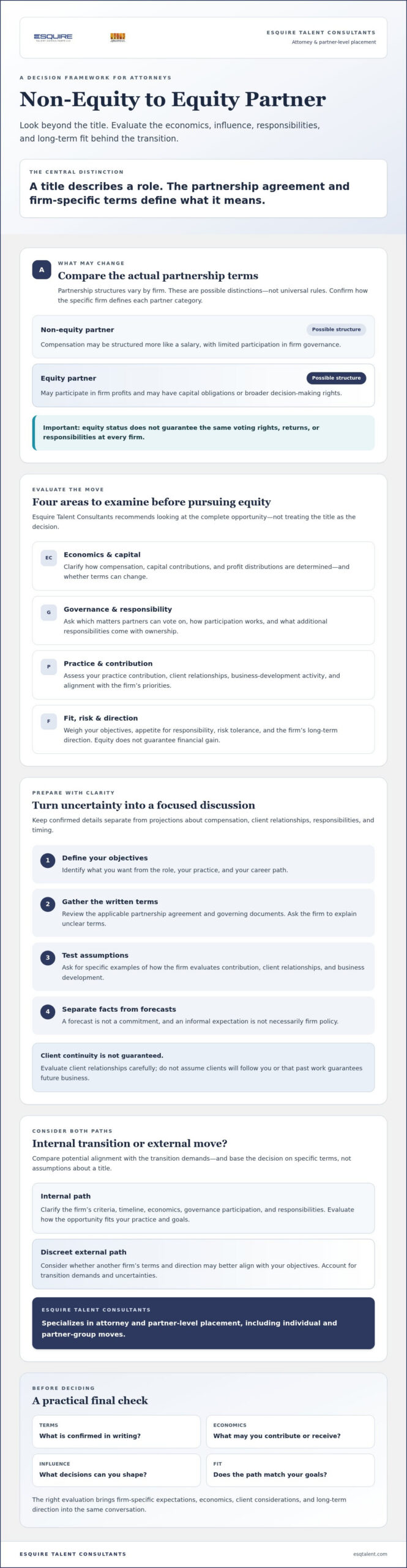
A partnership title describes a role; the partnership agreement and firm-specific terms determine its economics, governance rights, and responsibilities. That distinction is central to non-equity to equity partner moves. A change in title may reflect a shift in how a firm recognizes contribution, but the title alone does not establish what an attorney will earn, decide, or be expected to contribute.
At some firms, non-equity partners receive compensation structured more like a salary and have limited participation in firm governance, while equity partners participate in firm profits and may have capital obligations or broader decision-making rights. These are possible distinctions, not universal rules. Firms define partner categories differently, and equity status does not guarantee the same voting rights, returns, or responsibilities everywhere. The two-tiered partnership structure offers useful context, but the applicable partnership agreement and the firm’s own explanation should guide your understanding.
How do non-equity and equity partnerships differ?
Compare the actual terms, not assumptions associated with the title. Ask how compensation is determined, whether capital participation is expected, which governance matters partners can vote on, and what additional responsibilities come with the role. Review the relevant agreement and ask the firm to explain any terms that are unclear before treating a proposed transition as a defined change in status.
Why might an attorney consider moving into equity?
An attorney may view equity as a closer alignment between their contribution and the firm’s direction, or value having a greater voice in decisions that affect the practice. Others may be interested in participating in firm economics over time. None of these considerations guarantees a financial gain. The outcome depends on the firm’s terms and performance.
Motivations and available paths differ. Assess a move against your professional priorities, appetite for responsibility, and long-term fit rather than treating equity as the inevitable next step.
Which Factors Should Attorneys Assess Before Pursuing Equity?
Readiness involves more than meeting a title-based threshold. Assess how your practice contributes to the firm, the strength and nature of your client relationships, your business-development activity, and the expectations the firm has actually communicated. Ask for specific examples of how the firm evaluates those factors, and distinguish its stated criteria from assumptions based on another partnership model.
What should an attorney clarify about economics and governance?
Ask how the firm determines capital contributions, compensation, and profit distributions, and whether those terms can change. Clarify which decisions equity partners can vote on, how governance participation works, and what additional responsibilities accompany ownership. Review the applicable partnership agreement and other governing documents with appropriate advisors. A verbal summary may not capture the full terms. Esquire Talent Consultants focuses on attorney placement; the firm itself must confirm its specific arrangements.
How do practice contribution and portability fit the decision?
Consider whether your practice plans align with the firm’s priorities, including its expectations for client service, business development, and practice growth. The discussion of business development success underscores why relationship-building and developing work may matter alongside legal skill. Evaluate client relationships carefully, but do not assume clients will follow you or that past work guarantees future business. For a more focused review, see a legal partner portability analysis.
Finally, weigh ownership responsibilities against your objectives and risk tolerance. Consider whether you want greater influence and accountability, how the transition fits your practice plans, and what remains uncertain about economics or timing. If you are discreetly assessing an external partner-level move, contact Esquire Talent Consultants about partner placement.
How Can You Evaluate and Prepare for a Potential Transition?
A deliberate process can turn an uncertain prospect into a focused discussion. Start with your objectives, gather the firm’s written terms, test your assumptions, and organize a conversation around unanswered questions. Keep confirmed information separate from projections about compensation, client relationships, responsibilities, and timing. A forecast is not a commitment, and an informal expectation is not necessarily firm policy.
- Define your objectives: Identify what you want from the role, including professional influence, practice development, and the responsibilities you are prepared to assume.
- Gather the terms: Collect relevant agreements, written explanations, and materials describing the transition process.
- Test assumptions: Mark each point as confirmed, projected, or unknown, and identify who can verify it.
- Plan the discussion: Prioritize questions that will clarify readiness, process, and fit.
What questions belong in a transition discussion?
Ask how readiness is evaluated, which expectations are specific to the firm, and what evidence will inform the decision. Clarify who participates, what review stages apply, how governance changes, and whether the stated timing is firm or tentative. Ask what support, if any, accompanies a change in status. Confirm process details directly rather than treating another firm’s practices as a reliable guide.
How can a partner business plan support the conversation?
A business plan can organize your objectives, practice-development priorities, client-service approach, and assumptions about resources. It gives you a structured basis for discussing how your practice may align with firm priorities, while highlighting projections that need validation. A published law-firm partner business-plan guide can offer related planning ideas, but it cannot replace the firm’s governing documents or confirmed terms.
For attorneys considering non-equity to equity partner moves, preparation means knowing what you seek and what remains unresolved. Esquire Talent Consultants focuses on attorney and partner-level placement, including individual and partner-group moves, and can be a resource if you are evaluating an external opportunity. Discuss a potential partner-level move with Esquire Talent Consultants.
When Should You Explore an External Equity-Partner Move?
Exploring an external opportunity does not commit you to leaving. It gives you another point of comparison when your current firm’s direction, practice priorities, or partnership expectations seem misaligned. For attorneys weighing non-equity to equity partner moves, the question is not simply whether to pursue equity, but where the role’s terms and platform best fit their professional goals.
Compare three paths: remain in your current role, seek a clearly defined internal route to equity, or discreetly assess external possibilities. Use the same questions for each: Does the opportunity support your practice plans? Are governance expectations and responsibilities understood? What remains uncertain about timing, client continuity, or the transition itself? An external move may offer stronger alignment, but it also brings demands and unknowns. Persistent concerns are prompts for careful inquiry, not proof that departure is necessary.
What may make an external move worth exploring?
If the firm’s priorities repeatedly diverge from your practice goals, or the internal path remains unclear after direct discussion, it may be reasonable to learn what other firms could offer. Assess the prospective platform and its specific terms with the same care you apply internally. Do not assume that a new title guarantees better economics, greater influence, or a seamless transition.
How can Esquire Talent Consultants support a discreet exploration?
Esquire Talent Consultants focuses exclusively on attorney placement, including individual partner-level and partner-group lateral placements. If you are considering an external move, the firm can help you explore partner-level placement opportunities. Assess any potential fit and terms on their own merits. A measured conversation can help you decide whether further exploration aligns with your objectives, without treating a move as inevitable.
If you are ready to discuss your options, Discuss a partner-level move with Esquire Talent Consultants.
Make Your Next Partnership Decision with Clarity
Non-equity to equity partner moves call for more than evaluating a title. Clarify how your firm defines the role, examine the economics and governance terms, and assess whether its expectations align with your practice and long-term objectives. A deliberate process also helps separate confirmed terms from projections about timing, clients, and responsibilities.
Equity may be a meaningful next step, but it is not the only measure of a successful legal career. Consider the internal path alongside the possibility of an external move, weighing potential alignment against uncertainty and transition demands. Esquire Talent Consultants focuses exclusively on attorney placement, including individual partner and partner-group lateral placement, and can be a resource as you assess your options.
If you are considering an external partner-level opportunity, Discuss a partner-level move with Esquire Talent Consultants. Thoughtful preparation can help you move forward with greater confidence and a clearer view of what matters most.
Frequently Asked Questions
What is the difference between a non-equity partner and an equity partner?
A non-equity partner generally holds a partner title without the same ownership participation as an equity partner, but the distinction depends on the firm’s structure. Equity status may involve participation in firm profits, capital, or governance, while rights and responsibilities vary. Review the firm’s partnership agreement and ask for written explanations rather than relying on titles alone to establish what each role includes.
How does a non-equity partner become an equity partner?
The path is set by the firm, so there is no universal promotion process. Ask how readiness is assessed, what practice and business-development expectations apply, who makes the decision, and which review stages or approvals are involved. For non-equity to equity partner moves, clarify the expected timing and distinguish stated criteria from informal projections. Confirm firm-specific terms directly.
Does becoming an equity partner guarantee higher compensation?
No. Equity status does not guarantee higher compensation or a particular return. Compensation may depend on the firm’s distribution approach, financial performance, individual contribution, and other terms described by the firm. Before accepting a change in status, ask how compensation is determined, what financial commitments may apply, and which figures are estimates rather than confirmed terms. Review the governing documents with appropriate advisors.
Should I consider moving to another firm to pursue equity partnership?
Consider an external move if it may better align with your practice goals, governance expectations, or long-term plans, but treat those concerns as reasons to investigate rather than proof that you should leave. Compare the external opportunity with your current role and internal path, including transition demands and client continuity. Esquire Talent Consultants focuses exclusively on attorney placement, including individual partner and partner-group lateral placement.