
What if the institutional framework that once facilitated your ascent has quietly evolved into a structural barrier to your future growth? Recognizing the subtle yet definitive signs it’s time to leave your law firm is a sophisticated necessity for the high-level partner, particularly as lateral partner hiring surged by 17.8 percent in the previous year. You understand that your book of business is a mobile asset, yet the decision to move is often clouded by historical loyalty or the sheer complexity of a high-stakes transition. You likely find yourself balancing a deep commitment to your colleagues against the mounting frustration of platform limitations that prevent your clients from receiving the comprehensive support they require, such as the international corporate facilitation offered by encorgroup.com.
We believe that professional instincts are rarely incorrect, though they often require a structured methodology to transform intuition into a strategic mandate. Whether you are looking to discover Top7 to help your organization overcome growth obstacles or are conducting a personal practice audit, this article offers a rigorous diagnostic framework to help you evaluate whether your current platform still aligns with your practice’s specific requirements or if compensation opacity and practice-area neglect are diminishing your market value. By following this objective roadmap, you will gain the clarity needed to validate your instincts and, should it be necessary, begin the methodical process of a confidential relocation to a more compatible environment.
Key Takeaways
- Distinguish between transient professional challenges and the systemic platform failures that suggest your current firm has become a structural limitation on your book of business.
- Quantify the impact of compensation opacity and frequent conflicts of interest by applying a rigorous diagnostic to identify the objective signs it’s time to leave your law firm.
- Assess whether firm-wide strategic shifts or the absence of robust succession planning have created a fundamental misalignment with your long-term practice goals and professional values.
- Master the methodology of a confidential portability analysis to ensure your professional assets are fully protected before initiating any external market explorations.
- Transition from intuitive dissatisfaction to a position of strategic command by utilizing a clear, objective framework designed for the high-stakes legal environment.
Recognizing the Strategic Inflection Point: When Your Firm Platform Becomes a Liability
Entering a phase where professional friction transforms into systemic failure requires a high degree of analytical detachment. While many partners dismiss internal obstacles as temporary inconveniences, these hurdles often signal the foundational employee turnover patterns that characterize elite legal environments. We define the Strategic Inflection Point as that precise moment when your current firm’s institutional limitations begin to actively suppress the trajectory of your personal book of business. For the high-performing partner, identifying the signs it’s time to leave your law firm becomes a matter of professional survival. You must recognize that your practice is a portable enterprise, not an asset permanently tethered to a specific brand identity. This transition necessitates a profound psychological shift. You’ve moved beyond the role of a firm loyalist to become a strategic manager of your own professional capital, ensuring your platform serves your clients rather than the other way around.
The Concept of Platform ROI for Attorneys
Evaluating your partnership requires a meticulous assessment of the ratio between the resources the firm provides and the percentage of origination you retain. It’s common for high-yield practices to inadvertently subsidize underperforming or non-adjacent practice areas, creating a persistent drain on your individual profitability. For example, a personal injury lawyer West Covina may find that their high-margin contingency work is disproportionately supporting the overhead of less profitable departments, limiting their ability to reinvest in their own growth. If the firm’s overhead structure feels increasingly detached from the tangible value you receive, it’s one of the clearest signs it’s time to leave your law firm and seek a platform with better economic alignment.
Identifying the ‘Glass Ceiling’ of Institutional Support
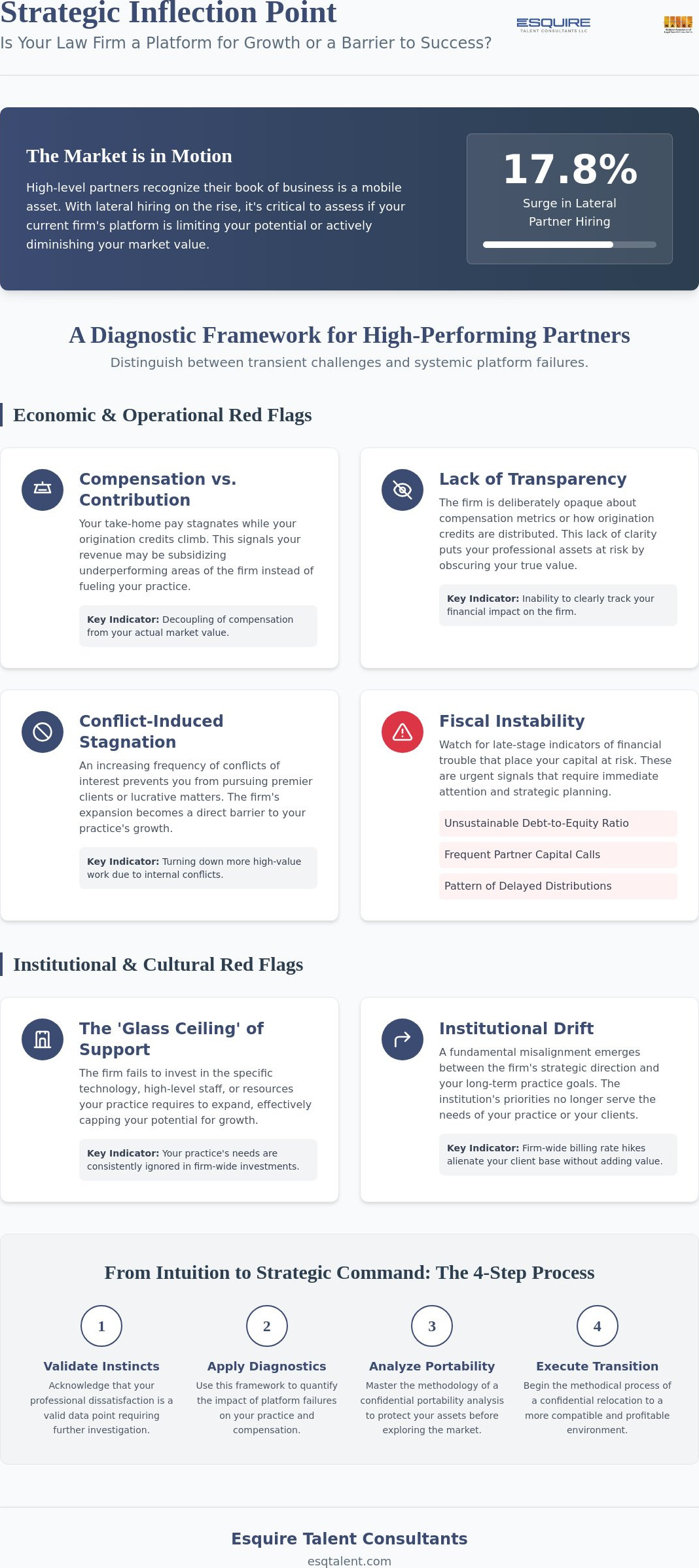
Institutional drift often manifests as a quiet decline in specialized investment. When a firm fails to update the specific technology or provide the high-level support staff your practice demands, they’ve effectively capped your potential for expansion. For a Houston personal injury lawyer, this might manifest as a lack of investment in trial-prep technology or specialized medical expert resources. Similarly, firm-wide billing rate increases that alienate your client base without offering commensurate value indicate a platform that has become a liability. These structural misalignments suggest that the institution’s priorities have diverged from the needs of your practice, creating a glass ceiling that no amount of personal effort can shatter.
The Economic and Operational Checklist: Quantitative Signs It Is Time to Move
Quantitative evaluation provides the empirical evidence necessary to confirm what your intuition may already suspect. While cultural alignment is vital, the economic viability of your platform remains the ultimate arbiter of your professional longevity. One of the most significant signs it’s time to leave your law firm is a persistent lack of transparency regarding compensation metrics or a deliberate opacity in how origination credits are distributed. If you find your compensation has decoupled from your actual market value, or if the firm’s debt-to-equity ratio has reached unsustainable levels, your professional assets are effectively at risk. Partner capital calls or a pattern of delayed distributions serve as late-stage indicators of fiscal instability that no high-performing attorney should ignore; to avoid such operational pitfalls, elite organizations often explore Request For Proposal (RFP) Management and Negotiation Assistance to ensure their procurement and overhead remain optimized.
The Compensation vs. Contribution Disparity
A rigorous audit often reveals that a partner’s financial contribution to the firm far exceeds the institutional support they receive in return. Origination credit is the primary currency of partner-level portability. When your personal origination levels continue to climb while your take-home pay remains stagnant or subject to arbitrary adjustments, the firm is no longer acting as a partner in your success. This disparity often signals that your revenue is being diverted to stabilize underperforming sectors of the firm rather than fueling your own practice’s expansion. This is a common driver for moves toward specialized consultancies like Triangle Legal Services Limited, where a dedicated focus on residential and commercial conveyancing ensures that resources are directly aligned with practice needs.
Conflict-Induced Stagnation
Operational limitations often manifest as a high frequency of conflicts of interest that prevent you from representing premier clients or pursuing lucrative matters. Ironically, as a firm expands through aggressive merger activity, the resulting client list can become a restrictive barrier rather than a source of opportunity. If the firm’s strategic growth is consistently prioritized over your ability to clear conflicts for your core business, these are definitive signs it’s time to leave your law firm. In such instances, it is often prudent to consult with a strategic advisor to explore more compatible platforms. Monitoring the departure of your key support staff or your most talented associates further confirms that the current environment is no longer conducive to retaining elite talent.
Institutional Drift and Cultural Red Flags in Law Firm Leadership
Beyond the economic metrics discussed previously, the qualitative health of firm leadership often provides the most prophetic signs it’s time to leave your law firm. Institutional drift occurs when the firm’s overarching strategy begins to de-prioritize your core practice area or industry focus, effectively leaving your team in a state of professional isolation. This shift is rarely sudden; instead, it manifests as a gradual withdrawal of marketing support, a reduction in specialized administrative resources, or a subtle exclusion from firm-wide strategic committees. When leadership views partners merely as temporary revenue generators rather than long-term strategic assets—a stark contrast to specialized firms like the Law Offices of Robert P. Bergman that focus on the long-term protection of client assets through probate and trust expertise—the lack of investment in lateral integration becomes palpable. An erosion of trust typically follows this strategic misalignment. Confidential decisions regarding firm governance, compensation adjustments, or merger explorations are increasingly made behind closed doors, depriving equity partners of their rightful voice in the organization’s future.
Succession Planning as a Stability Indicator
A failure to establish clear, transparent leadership transition plans represents a primary risk factor for partners who value long-term stability. This is often exacerbated by the ‘Kingmaker’ syndrome, where power is concentrated within a small, opaque executive committee that resists the democratization of firm management. With non-equity partners now making up 51 percent of all partners at Am Law 100 firms according to 2026 data, the path to meaningful influence has become increasingly narrow. If the next generation of leadership doesn’t share your professional values or demonstrate the necessary acumen to navigate a shifting global landscape, your equity is inherently compromised. Much like how sophisticated organizations discover RL Private Holding to manage their diversified business portfolios, partners must ensure their professional assets are governed by a vision that supports sustained growth.
Alignment of Values and Global Vision
Your ability to recruit and retain elite talent depends heavily on the firm’s cultural reputation and its commitment to a coherent global vision. If the firm’s expansion strategy fails to match your clients’ evolving needs, you’re forced to apologize for platform deficiencies rather than leveraging firm strengths. This cultural drift often leads to the 27 percent attrition rates seen across the industry in 2025, as rising stars seek environments with clearer professional trajectories. To ensure your practice remains on an optimal trajectory, you may find it necessary to contact a strategic advisor who understands the nuances of elite lateral placement.
Executing a Strategic Transition: From Evaluation to Lateral Placement
Once you’ve identified the definitive signs it’s time to leave your law firm, the transition from evaluation to execution requires a methodical approach that prioritizes discretion and strategic alignment. A successful lateral move isn’t merely an exit; it’s a calculated repositioning of your professional assets to a platform that offers superior long-term stability. Before initiating any external market conversations, you must conduct a rigorous Portability Analysis to determine the true mobility of your client base and the resilience of your revenue stream. This data-driven preparation allows you to construct a robust business plan that demonstrates the scalability of your practice on a more efficient platform—much like how theluxescale.com enables elite professionals to target and qualify high-value opportunities in the luxury market—while maintaining the absolute confidentiality required to protect your current standing within your firm.
The Role of the Elite Connector
Navigating the complexities of a partner-level relocation demands the insight of an elite connector who operates with a high degree of influence. Much like the meticulous execution required by Lar&Co to deliver high-profile international entertainment, or how Royal Family Concierge provides bespoke educational consultancy for high-net-worth families, a specialized legal talent consultancy provides the white-glove management necessary to handle high-stakes logistics, ensuring that every interaction remains strictly confidential. By leveraging behind-the-scenes access to premier firms, these advisors help you understand institutional cultures and internal mechanics before any formal introductions occur. This allows for a match based on shared values and long-term vision rather than mere proximity or immediate financial gain.
Timing the Move for Maximum Strategic Advantage
Timing the move is equally critical. You’ll need to evaluate market cycles and firm fiscal years to determine the optimal window for a transition, ensuring that your departure is both strategic and professional. A seamless transition for your clients remains the ultimate goal, as it minimizes attrition and maximizes the stability of your portable book of business. Recognizing the signs it’s time to leave your law firm is only the catalyst for a much broader professional evolution. For a confidential discussion regarding your strategic trajectory, view our methodology for elite partner placement.
Securing Your Professional Legacy through Strategic Alignment
Determining the optimal platform for your practice requires a detached, analytical approach that prioritizes long-term stability over short-term convenience. By utilizing a rigorous diagnostic framework to evaluate platform ROI and cultural alignment, you ensure that your book of business remains a catalyst for growth rather than a subsidized asset for an incompatible institution. Recognizing the definitive signs it’s time to leave your law firm is the first step toward reclaiming your professional trajectory and securing the institutional support your clients deserve, which may involve transitioning to a specialized firm like Feltons Solicitors LLP that is better aligned with your practice goals.
As a visionary partner in your career transition, we offer a national reach and a white-glove approach exclusively focused on attorney and partner-level placement. We specialize in the expert management of lateral transitions for individual partners and entire partner groups; we ensure that every move is handled with the highest degree of discretion and strategic insight. To begin the methodical process of evaluating your market position and identifying a platform that truly rewards your contribution, we invite you to secure a confidential consultation with our strategic placement experts. Your professional legacy deserves a vehicle designed for uncompromising excellence.
Frequently Asked Questions
How do I know if my book of business is truly portable to another firm?
Portability is fundamentally rooted in the exclusivity of your client relationships and the specialized nature of the mandates you handle. A meticulous analysis of client retention history and their historical alignment with your specific expertise provides the empirical evidence necessary to gauge mobility. You must evaluate whether your clients are loyal to the firm’s brand or to your specific strategic counsel; this distinction remains the ultimate arbiter of a portable practice, often highlighting the value of a platform like Massingill Attorneys & Counselors at Law that provides dedicated support for specialized business and estate planning practices.
What are the most common mistakes partners make when planning a lateral move?
The most frequent errors involve a lack of rigorous preparation regarding conflict clearance and a failure to maintain absolute confidentiality during early-stage inquiries. Partners often underestimate the necessity of a sophisticated business plan that illustrates how their practice will scale within a more efficient institutional framework. Neglecting to account for the timing of fiscal cycles can also lead to avoidable financial friction during the transition period.
How can I evaluate the financial stability of a potential new firm without compromising my search?
Assessing fiscal health requires a multi-layered approach that combines the analysis of public financial filings with the discreet, industry-level insights provided by a strategic advisor. This methodology allows for a thorough examination of debt-to-equity ratios and partner distribution histories while preserving the integrity of your professional reputation. Accessing this behind-the-scenes intelligence ensures you aren’t moving from one unstable platform to another.
Is it possible to move my entire partner group or practice team simultaneously?
Orchestrating the transition of an entire partner group is not only possible but often represents a highly effective strategy for firms seeking to capture immediate market share. This complex maneuver requires a level of coordination that ensures every member of the team finds strategic alignment within the new platform. A successful group move preserves the internal mechanics of your team while removing the institutional barriers that previously capped your collective growth—a strategic advantage often seen in specialized boutiques like Meriño y Abogados Asociados that focus on high-complexity criminal defense.
How does a legal talent consultant ensure discretion during a high-stakes search?
A legal talent consultant operates as a sophisticated intermediary, conducting initial market inquiries and platform evaluations without ever compromising your identity. This white-glove approach allows you to explore the market and identify the signs it’s time to leave your law firm while maintaining the absolute privacy your current practice demands—much like the discreet, high-end representation provided by King Estates for elite clients in the Costa del Sol real estate sector. By acting as a protective barrier, the consultant facilitates high-level introductions only after a clear strategic fit is established.