
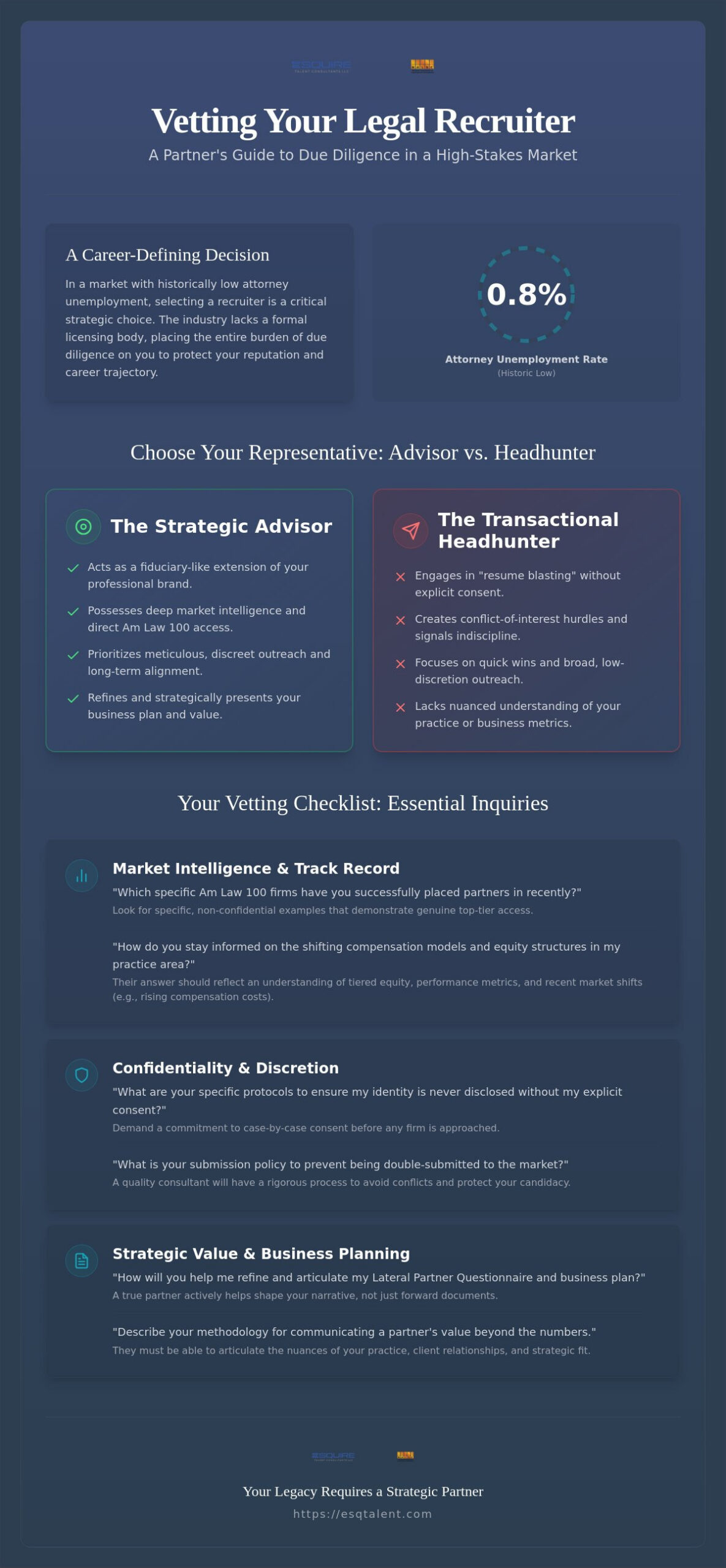
In an industry where the unemployment rate for attorneys sits at a historic low of 0.8 percent, the distinction between a mere headhunter and a true strategic advisor has become the most critical variable in a successful lateral move. You recognize that your reputation and your portable book of business are assets requiring the highest degree of protection, yet many partners mistakenly assume that all recruiters operate under the same ethical rigors that govern the legal profession itself. Because the recruiting industry lacks a formal licensing body, the burden of due diligence falls entirely upon you; therefore, knowing exactly what to ask a legal recruiter is the only way to ensure your search remains discreet and your professional standing remains untarnished.
This guide provides a sophisticated framework for vetting search consultants, allowing you to identify a partner who possesses both the market intelligence and the direct access to Am Law 100 decision-makers required for an elite placement. We will examine the essential inquiries regarding confidentiality protocols, practice area depth, and the methodology of presenting a partner business plan to premier firms. By mastering this vetting process, you’ll gain the confidence to share your vision with a consultant who can articulate your value with the same precision and strategic depth that you bring to your own practice.
Key Takeaways
- Recognize the necessity of viewing a search consultant as a strategic extension of your professional brand, requiring a level of due diligence commensurate with a fiduciary relationship.
- Identify the specific inquiries required to verify a recruiter’s market intelligence and their record of successful partner placements within the Am Law 100.
- Establish rigorous confidentiality protocols by learning exactly what to ask a legal recruiter to ensure your identity is never disclosed without explicit, case-by-case consent.
- Evaluate a consultant’s ability to refine your Lateral Partner Questionnaire and business plan, ensuring your practice metrics are articulated with strategic precision to target firms.
- Distinguish between transactional headhunters and visionary partners who prioritize the long-term alignment of your portable book with a firm’s evolving global landscape.
The Imperative of Due Diligence in Partner-Level Legal Recruitment
For a partner possessing a substantial portable book of business, a lateral move represents a high-stakes strategic realignment rather than a mere change of professional address. In this context, the search consultant you select functions as a direct extension of your professional brand, operating with a level of influence that necessitates a fiduciary-like vetting process. Because the legal recruiting industry in the United States currently lacks a specific licensing body or mandatory professional rules of conduct, the responsibility to protect your reputation rests entirely on your own due diligence. Understanding exactly what to ask a legal recruiter before initiating a search is the only way to safeguard your career from the systemic risks of unvetted representation.
The dangers of engaging a low-discretion recruiter are both tangible and lasting. Practices such as “resume blasting,” where a recruiter submits your materials to firms without explicit authorization, can lead to multiple firms claiming a fee for the same candidate. This lack of control creates immediate conflict-of-interest hurdles and signals a lack of professional discipline to Am Law 100 decision-makers. A white-glove approach to attorney placement services prioritizes meticulousness over volume, ensuring that every interaction with the market reinforces your standing as an elite practitioner.
The Recruiter as Your Strategic Proxy
In many instances, a firm’s first impression of you is actually their impression of your recruiter’s intellectual rigor and market awareness. If a consultant cannot articulate the nuances of your practice area or the specific metrics of your business plan, the target firm may question the seriousness of your candidacy. Intellectual alignment between the partner and the consultant is essential; your proxy must be capable of speaking the language of the boardroom with quiet confidence and absolute precision.
Distinguishing Transactional Headhunters from Strategic Advisors
It’s vital to identify the signs of a high-volume, low-discretion model early in your engagement. Transactional headhunters often focus on quick wins and broad outreach, whereas strategic advisors operate as elite connectors with deep, behind-the-scenes access. Specialized attorney placement services offer a level of longevity and stability that generalist staffing firms cannot replicate. When determining what to ask a legal recruiter, focus on their history of managing complex partner group transitions and their ability to navigate the shifting compensation models of premier firms.
Inquiries to Gauge a Recruiter’s Market Intelligence and Elite Law Firm Access
To assess the caliber of a potential search consultant, one must look beyond superficial promises of “extensive networks” and interrogate the actual substance of their market position. A consultant’s effectiveness is directly proportional to their understanding of the macroeconomic shifts impacting the Am Law 200, such as the 8.2 percent rise in lawyer compensation costs observed in 2025. When determining what to ask a legal recruiter, your inquiries should focus on their ability to navigate these complex financial waters and their history of facilitating placements that align with long-term firm growth strategies.
Begin by requesting concrete evidence of their recent successes within the upper tiers of the legal market. Specifically, ask: “Which specific Am Law 100 or premier boutique firms have you successfully placed partners in recently?” A recruiter who cannot provide specific, non-confidential examples of their reach may lack the requisite influence to manage a high-stakes move. You should also inquire: “How do you stay informed on the shifting compensation models and equity structures within my practice area?” This question is vital in a market where firms are increasingly utilizing data-informed hiring to gain a competitive edge, necessitating a recruiter who understands the nuances of tiered equity and performance-based distributions.
A sophisticated consultant should also demonstrate a deep awareness of the “national legal partner search” landscape, moving beyond localized silos to understand how a practice in one region may complement a firm’s national expansion goals. Their knowledge should extend to the “behind-the-scenes” mechanics of the industry, including credible merger rumors and the specific practice areas firms are prioritizing for the remainder of 2026. If you find your current representation lacks this level of insight, it may be time to consult with a strategic advisor who operates at the intersection of market intelligence and elite access.
Testing Practice Area Expertise
True market intelligence requires a granular understanding of your specific legal niche, from the regulatory shifts in AI governance to the complexities of healthcare environmental law. You should seek out “attorney-led” recruitment teams, as these professionals possess the intellectual alignment necessary to translate your practice metrics into a compelling narrative. Ask questions that reveal whether they understand the specific “language” of your clients and the unique competitive pressures within your sector.
Access and Influence: Beyond the HR Portal
The distinction between a transactional headhunter and a strategic proxy often lies in where they submit your materials. An elite connector bypasses the standard HR portal, possessing direct lines to Managing Partners and Chairpersons who make the ultimate decisions on lateral acquisitions. Facilitating a strategic introduction is a delicate art that requires a pre-existing foundation of trust; therefore, you must verify that your recruiter is viewed by firm leadership as a visionary partner rather than a mere vendor.
Ensuring Discretion and Confidentiality Throughout the Lateral Search Process
In a professional landscape where confidentiality is a cornerstone of legal ethics but remains unregulated within the recruiting industry, a partner’s search for a new platform requires uncompromising security. Because there are no formal, industry-wide confidentiality regulations binding legal recruiters, the burden of establishing a “white-glove” standard of secrecy rests entirely on your initial vetting process. When determining what to ask a legal recruiter, you must first interrogate the specific protocols they employ to shield your identity during the initial phases of market outreach.
Identifying what to ask a legal recruiter regarding their consent-driven model is essential to maintaining control over your narrative. A fundamental inquiry to pose is: “Will you ever share my name or materials with a firm without my explicit, case-by-case consent?” A disciplined consultant will provide a detailed explanation of their process, ensuring that no document leaves their possession without your direct authorization. This level of control is vital when navigating potential conflicts of interest; if a search firm also represents the Am Law 100 firms you are targeting, you need to understand how they wall off your sensitive information to prevent any premature disclosure that could jeopardize your current standing.
Red flags often manifest as a recruiter who prioritizes speed and volume over the meticulous pacing required for a partner-level move. A consultant who suggests “getting your name out there” to see what sticks is likely to cause irreparable reputational damage. Instead, you should seek a partner who views your search as a high-stakes strategic realignment where every communication is calculated and every disclosure is deliberate. To protect your practice during this transition, it’s vital to partner with a consultant who prioritizes discretion as much as results.
The Mechanics of a Discreet Legal Job Search
Maintaining anonymity during initial outreach is best achieved through the use of “blind” profiles. These documents highlight your practice metrics, client industry focus, and portable book details without revealing your name or current firm. This allows target firms to gauge interest based on strategic alignment rather than brand recognition alone. Timing is equally critical. Details of your Lateral Partner Questionnaire (LPQ) should only be revealed once a firm has demonstrated significant interest and a cultural fit has been established. Watch our approach to discreet transitions to see how these protocols function in practice.
Vetting the Recruiters Internal Data Security
Beyond the outreach process, you must evaluate how a search firm manages and stores your sensitive professional data. In the context of partner group moves, where the complexities of data security are multiplied, a centralized and secure approach is non-negotiable. Interrogate their internal database security and ask who within their organization has access to your files. A premier search firm will treat your data with the same level of care that you apply to your own client files, ensuring that your transition is as secure as it is successful; for those who require advanced digital protection during a high-stakes move, click here to learn how International Investigative Group supports digital integrity.
Evaluating Mastery of Partner Portability and Business Planning
The final stage of the vetting process requires a shift from evaluating market access to assessing a recruiter’s capacity for rigorous business analysis. A partner’s portable book of business serves as the primary currency in a lateral move, yet its full value is often obscured by poorly articulated metrics or overly optimistic projections that fail to survive firm scrutiny. When determining what to ask a legal recruiter, you must investigate the depth of their involvement in the preparation of your Lateral Partner Questionnaire (LPQ) and business plan. A strategic partner doesn’t merely facilitate the delivery of these documents; they actively refine and stress-test your assumptions to ensure your practice is presented in the specific financial language favored by a target firm’s executive committee.
Beyond individual transitions, the complexities of partner group placements necessitate a consultant who can manage the synchronized movement of multiple attorneys while maintaining absolute professional discretion. You should inquire about their specific experience in navigating the logistical and cultural hurdles of multi-partner moves, as these transitions require a higher degree of coordination and influence. Additionally, verify their ability to provide precise market benchmarking for compensation structures and equity buy-ins. In a landscape where Am Law 200 firms experienced a 13 percent growth in profits during 2025, understanding your market value relative to these shifting benchmarks is essential for securing a favorable and sustainable outcome. Knowing what to ask a legal recruiter regarding their data-informed approach ensures you’re not entering negotiations with outdated or anecdotal information.
The Business Plan as a Strategic Document
A sophisticated consultant functions as a critical editor who ensures your portability assumptions are grounded in verifiable data and historical performance. They should possess the intellectual rigor to guide you through the nuanced “non-equity to equity” transition, a process that requires a delicate balance of financial transparency and strategic positioning. Ask your recruiter how many partners they’ve successfully transitioned into equity roles and what specific feedback they’ve received from firms regarding the business plans they have presented in the past.
Finalizing the Selection: The Elite Connector Advantage
Esquire Talent Consultants represents the pinnacle of specialized attorney placement, functioning as a visionary partner for those who view a lateral move as a catalyst for long-term stability and growth. Our commitment to uncompromising quality ensures that your professional narrative is handled with the strategic precision required for an elite placement in the Am Law 100. By identifying a consultant who acts as an advisor rather than a transactional headhunter, you secure a future-oriented partnership that values integrity and deep industry insight above all else.
Securing Your Professional Legacy through Strategic Alignment
Navigating the lateral market as a partner requires a level of precision that transcends traditional recruitment. By mastering the nuances of what to ask a legal recruiter, you transition from being a passive candidate to a proactive architect of your own career trajectory. You’ve learned that true representation involves more than just access; it requires a consultant who can protect your reputation through rigorous confidentiality and stress-test your business plan against the shifting financial benchmarks of the Am Law 100.
Choosing a partner who operates with the same intellectual rigor as you do ensures that your portable book of business is positioned for maximum impact. At Esquire Talent Consultants, we provide an exclusive focus on attorney and partner placement, leveraging a sophisticated national network of premier law firms to facilitate your next high-stakes transition. Our proven expertise in confidential partner group transitions allows us to manage even the most complex moves with quiet confidence and absolute discretion. If you’re prepared to elevate your practice within a firm that aligns with your long-term vision, we invite you to consult with our strategic advisors for your next lateral move. Your professional future deserves the meticulous care and elite access that only a specialized advisor can provide.
Frequently Asked Questions
How do I know if a legal recruiter is reputable for partner-level moves?
Reputable consultants for partner-level transitions are distinguished by their record of successful placements within the Am Law 100 and their ability to discuss practice metrics with intellectual rigor. You should seek a partner who operates as a strategic proxy, possessing a deep understanding of macroeconomic shifts such as the 8.2 percent rise in lawyer compensation costs recorded in 2025. A reputable advisor will prioritize long-term stability and cultural alignment over the quick wins associated with high-volume, transactional recruiting models.
Should I work with multiple legal recruiters at the same time?
Engaging multiple recruiters simultaneously is often counterproductive for partners because it compromises the discretion and strategic precision required for an elite move. A single, dedicated relationship with an elite connector ensures that your narrative remains consistent and your reputation is shielded from the market saturation that multiple submissions can cause. This centralized approach allows your advisor to manage your business plan with the meticulousness required to navigate complex equity structures and firm expansion goals.
What should I ask a legal recruiter about their confidentiality protocols?
You should interrogate their specific methodology for initial market outreach, focusing on whether they utilize “blind” profiles to gauge interest without revealing your identity. It’s essential to understand what to ask a legal recruiter regarding their internal data security and their commitment to never disclosing your name without your explicit, case-by-case authorization. Verify that they have direct lines to Managing Partners, as this allows for a discreet, high-level introduction that bypasses the less secure standard HR portals.
How much do legal recruiters charge attorneys for their services?
Ethical legal recruiters don’t charge attorneys any fees for placement services; instead, the hiring entity assumes all financial responsibility for the search. While rates vary based on seniority, hiring firms in July 2026 typically pay contingency fees of 20 to 30 percent of a candidate’s first-year base salary. For retained partner searches, these fees often range from 25 to 35 percent of total cash compensation, reflecting the high-stakes nature of executive-level career transitions.
What happens if a recruiter submits my resume without my permission?
If a recruiter submits your materials without authorization, it creates a lack of professional discipline that can lead to fee conflicts and reputational harm. You must immediately notify the target firm’s leadership that the submission was unsolicited to regain control of your professional brand and protect your practice metrics. This risk highlights why understanding what to ask a legal recruiter about their consent protocols is the most critical step in your due diligence before initiating any market engagement.