
What does a partner compensation figure tell you when firms define partnership, profit, and contribution differently? Legal partner compensation benchmarking can offer a useful point of reference, but a headline average may conceal more than it reveals if equity status, seniority, practice mix, and individual contribution are not comparable. For firm leaders and partners weighing their options, those distinctions matter.
Public figures can help frame a discussion, but they cannot determine on their own whether compensation is competitive or fair. Esquire Talent Consultants considers compensation context alongside alignment, opportunity, and long-term fit, recognizing that these decisions affect both talent relationships and firm economics.
This guide explains what benchmarks can and cannot show, how to compare figures using consistent definitions and relevant context, and how to apply market information thoughtfully to recruitment, retention, and firm growth. Esquire Talent Consultants helps firms and partners consider lateral moves and group transitions with greater clarity, without mistaking a single number for the whole picture.
Key Takeaways
- Use legal partner compensation benchmarking as a structured comparison, not a universal pay scale or automatic recommendation.
- Compare partners using consistent definitions, including role, equity status, practice area, seniority, and compensation components.
- Follow a disciplined process: define the question, select relevant peers, align the measures, and interpret differences cautiously.
- Consider compensation context alongside alignment, opportunity, and long-term fit when weighing retention, lateral recruitment, or group transitions with Esquire Talent Consultants.
What Legal Partner Compensation Benchmarking Can, and Cannot, Tell You
Legal partner compensation benchmarking is a structured comparison of compensation information across relevant peers. It can frame a market discussion, but it is neither a universal pay scale nor an automatic recommendation for what a firm should pay. Its usefulness depends on whether the figures use consistent definitions and reflect meaningfully similar roles and firm structures.
A market benchmark describes compensation within a defined comparison group; an individual compensation decision applies a firm’s policies and judgment to a partner’s role, contribution, and circumstances. That distinction matters because partnership arrangements differ, including in how partners share profits and hold equity. A foundational overview of law firm partnership structures can help clarify why the title “partner” alone does not establish comparability.
Which compensation components belong in a comparison?
Before comparing figures, identify what each source counts, excludes, or reports separately. Compensation may include salary, draws, distributions, bonuses, or other elements, depending on the firm’s structure and the source’s methodology. Cash compensation and total compensation are not interchangeable if the total measure includes components absent from a cash-only figure. When definitions are unclear, note the gap and avoid treating the figures as equivalent.
Why a benchmark is not a compensation verdict
A headline figure can obscure differences in equity status, responsibilities, seniority, firm economics, and individual contribution. An equity partner’s share of firm profits, for example, may not be comparable to a non-equity partner’s salary and bonus. Even partners with the same title may have different roles and contributions. Market data provides context; a firm’s compensation policy determines how that context informs its decisions.
Esquire Talent Consultants specializes in attorney and partner-level placements, including individual lateral moves and partner-group transitions. In these talent discussions, compensation is considered alongside opportunity, alignment, and long-term fit. Understanding what a benchmark can and cannot establish helps firms and partners interpret market context carefully.
How to Compare Legal Partner Compensation on a Like-for-Like Basis
A useful comparison starts with a defined peer group, not simply the largest available dataset. Match firms and partners to the question at hand, then record each source’s publication date, sample scope, and methodology. If a source does not explain what its figures include, note that limitation rather than filling it with assumptions. Benchmark comparisons are meaningful only when definitions are consistent and the peer group reflects the decision being considered.
Build a consistent comparison
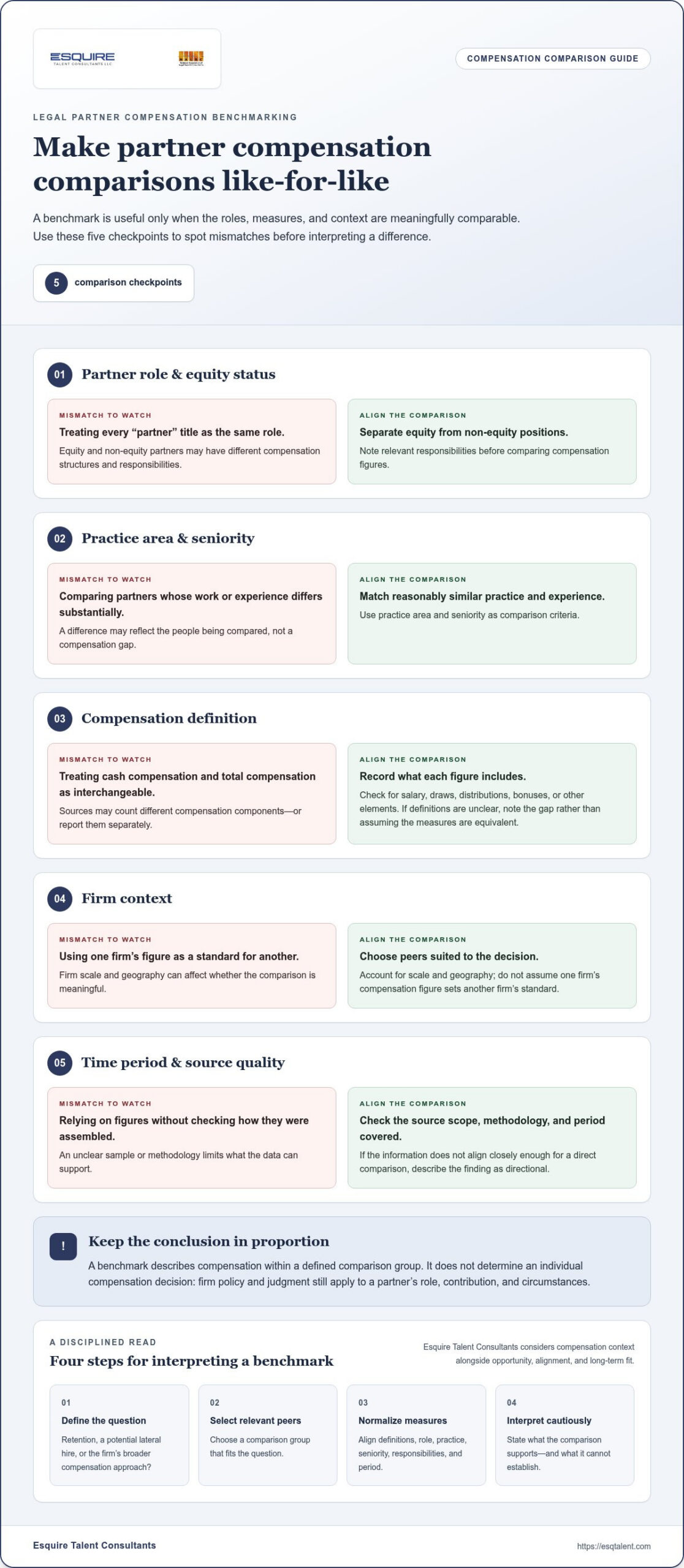
Before interpreting results, organize the available information using the same criteria:
- Partner role and equity status: distinguish equity from non-equity positions and note relevant responsibilities.
- Practice area and seniority: compare partners with reasonably similar work and experience.
- Compensation definition: identify whether figures describe salary, draws, distributions, bonuses, or total compensation.
- Firm context: account for scale and geography, which can affect comparability without making one firm’s figure a standard for another.
- Time period: check that the data covers a period relevant to the decision.
These distinctions help prevent differences in role or structure from being mistaken for a compensation gap. Esquire Talent Consultants applies a disciplined reading of market context when compensation informs partner recruitment or retention.
Read financial indicators in context
Collections and realization describe aspects of firm economics, but do not capture an individual partner’s complete value on their own. A firm-level indicator may reflect shared systems, client mix, or collective performance, while an individual contribution measure addresses a different question. LeanLaw’s discussion of realization and collections is an illustration of operational reporting, not evidence of market compensation.
For talent decisions, Esquire Talent Consultants considers compensation context alongside opportunity and long-term alignment. Firms assessing a potential lateral move can also discuss strategic lateral partner hiring with Esquire Talent Consultants.
A Practical Framework for Interpreting Partner Compensation Benchmarks
Use benchmarks to frame a decision, not make it. A disciplined process helps distinguish a genuine compensation difference from variation in role, firm structure, or individual contribution.
- Define the question. Clarify whether you are assessing retention, a potential lateral hire, or the firm’s broader compensation approach.
- Select relevant peers. Choose a comparison group suited to the question instead of defaulting to the broadest available sample.
- Normalize the measures. Align compensation definitions and account for equity status, practice, seniority, responsibilities, and the period covered.
- Interpret cautiously. Identify what the comparison supports, what it cannot establish, and which differences warrant further discussion.
If the available information does not align closely enough to support a direct comparison, describe the finding as directional. Do not present it as a precise measure of a partner’s market position.
Separate market position from partner-specific contribution
Assess responsibility, practice development, client relationships, and contributions to the firm as distinct considerations. None determines compensation or predicts future performance on its own. If a benchmark suggests a gap, first examine whether the partners being compared have similar roles and measures of contribution. Esquire Talent Consultants treats market context as one part of a broader talent assessment, not a substitute for professional judgment or firm policy.
Use benchmarking in retention and recruitment discussions
In a retention or recruitment conversation, pair market context with role expectations, opportunity, and long-term alignment. Esquire Talent Consultants handles individual partner moves and partner-group transitions as strategic talent decisions, with compensation as one element of fit. For a wider view of hiring conditions, consider the article on lateral partner recruitment trends alongside your firm’s specific circumstances.
When a partner move is under consideration, discuss a strategic partner placement with Esquire Talent Consultants.
Turn Compensation Benchmarking Into a More Informed Talent Strategy
A responsible benchmark brings together comparable data, clearly stated limitations, and a defined decision question. Legal partner compensation benchmarking can help a firm consider how its approach aligns with relevant market context, but the findings should inform discussion rather than dictate a decision. Before acting, document what the comparison supports and where uncertainty remains.
Connect benchmark insights to partner mobility
Compensation may shape a partner’s view of a potential move, but it is only one part of the assessment. Practice fit, development opportunity, client relationships, responsibilities, and alignment with the firm’s direction also matter. Esquire Talent Consultants focuses on attorney and partner placements, including individual lateral moves and partner-group transitions, where these considerations need to be weighed together. For firms considering attorney placement, market context can frame the conversation without reducing fit to a single figure.
In retention discussions, a benchmark may prompt a closer look at whether expectations and opportunities are aligned. In lateral recruitment or group transitions, it can provide a shared starting point for evaluating the broader proposition. Esquire Talent Consultants approaches these moves as strategic talent decisions, not compensation comparisons alone.
Decide on a thoughtful next step
Before turning analysis into action, record the question the benchmark is meant to answer, the basis for comparison, and any unresolved gaps in the information. This helps firm leaders distinguish a useful signal from a conclusion the evidence cannot support. Esquire Talent Consultants can address strategic attorney placement needs in the context of a partner’s or group’s goals, responsibilities, and prospective firm alignment.
Discuss a strategic partner move with Esquire Talent Consultants
Make Market Context Part of a Deliberate Talent Decision
Legal partner compensation benchmarking is most useful when figures are interpreted with their definitions, limitations, and peer group in view. A benchmark can provide market context, but it cannot replace a firm’s judgment about role, contribution, or policy. Keeping those distinctions clear helps turn compensation information into a more thoughtful input for retention, lateral recruitment, and partner-group transitions.
Compensation is only one part of a partner’s decision. Opportunity, practice alignment, relationships, and long-term fit matter too. Esquire Talent Consultants focuses exclusively on attorney placements, working with individual partner attorneys and partner groups for law firms across the United States. That focus informs a broader perspective on how partner moves fit within firm and career priorities.
If your firm is considering an individual partner move or a group transition, discuss a strategic partner move with Esquire Talent Consultants. A measured conversation can help clarify the talent decision ahead and the context that matters most. With careful comparison and a clear view of long-term alignment, firms and partners can move forward with greater confidence.
Frequently Asked Questions
What is legal partner compensation benchmarking?
Legal partner compensation benchmarking is the structured comparison of partner compensation information against a relevant peer group. Its usefulness depends on consistent definitions, including which compensation components are counted and how partner roles are grouped. A benchmark provides market context, not an automatic pay recommendation. Firms should interpret it alongside each partner’s responsibilities and the firm’s compensation structure before drawing conclusions.
What factors should law firms consider when benchmarking partner compensation?
Start by defining the compensation measure, then assess partner role, equity status, practice area, seniority, and firm structure. Review the data source’s sample, methodology, and publication date as well. The relevant factors depend on the decision, such as evaluating retention or considering a lateral hire. Documenting comparison assumptions makes it easier to identify what the figures can show and where differences remain.
Can law firms compare equity and non-equity partner compensation?
Yes, provided the source clearly defines each category and the comparison accounts for differences in structure. Equity and non-equity partners may have distinct compensation arrangements and responsibilities, so their figures should not automatically be treated as equivalent. Identify which components are included, such as salary, distributions, or bonuses, and present the results as context rather than a direct ranking of partner value.
How often should a law firm review partner compensation benchmarks?
A firm can review benchmarks when addressing a defined compensation, retention, or recruitment question, or when relevant market information becomes available. There is no universal review interval suited to every firm. Record the publication date and methodology for each source, and explain limitations when comparing information from different periods or sources. This helps decision-makers avoid treating older or differently defined figures as directly equivalent.
Do compensation benchmarks determine what a lateral partner should earn?
No. A benchmark can frame market context, but it cannot fully account for a partner’s responsibilities, contributions, practice opportunity, or the firm’s compensation model. Use it as one input alongside the firm’s decision criteria, role expectations, and long-term alignment. Esquire Talent Consultants focuses on strategic attorney and partner placements, including individual lateral moves and partner-group transitions, where compensation is one consideration in the broader move.