
What if the question is not whether your current firm has disappointed you, but whether its direction still supports the practice and career you intend to build? A difficult quarter or a strained relationship may pass; persistent misalignment in economics, leadership, client support, or growth prospects may point to a more structural concern. Distinguishing between the two is central to deciding when to make a lateral partner move.
Exploring a move does not require an immediate decision, or a willingness to put client relationships and professional reputation at risk. It calls for a measured assessment of whether the concerns are enduring, whether another platform could strengthen your long-term prospects, and whether you are prepared to evaluate alternatives thoughtfully. This guide considers the professional, economic, and personal signals that can make exploration timely, while helping you separate strategic readiness from short-term frustration. Once you have assessed your position, Esquire Talent Consultants can serve as a discreet resource for considering potential opportunities and firm alignment. A deliberate first step can clarify your options without committing you to a move.
Key Takeaways
- Assess whether sustained shifts in platform support, practice direction, or leadership confidence are affecting your long-term goals.
- To judge when to make a lateral partner move, examine portability, client continuity, and prospective firm fit rather than assuming they will transfer seamlessly.
- Define your objectives and evaluation criteria before considering selected conversations; exploring options does not obligate you to accept an offer.
- Esquire Talent Consultants can help connect partner-level talent with law firms across the United States when you are ready to assess strategic alignment.
When to Make a Lateral Partner Move: Recognize the Signals That Matter
A difficult quarter or an isolated disagreement, even one involving a consequential decision, does not by itself establish that a move is warranted. The more meaningful question is whether the same barriers continue to constrain your practice and professional direction. Consider signals across several areas: whether the firm’s platform supports practice development, whether its priorities align with your practice’s trajectory, whether you retain confidence in leadership, and whether your role still advances your long-term goals.
A partner title can encompass different roles and arrangements; the overview of Partner (business rank) provides context on distinctions such as equity and non-equity partnership. Your own assessment should look beyond title to whether your responsibilities, influence, and available support fit the practice you intend to build. No single signal proves a move is right. Together, recurring patterns may justify a broader review. Esquire Talent Consultants can be a strategic resource once you have clarified what matters to you.
Which professional signals deserve sustained attention?
Recurring barriers deserve attention when they materially limit practice development, such as persistent difficulty accessing resources or building the internal support needed to pursue your objectives. A temporary workload spike may ease; a single conflict may be resolved. By contrast, repeated obstacles across matters or planning cycles can suggest a lasting platform misalignment. Look at patterns, not isolated events, and consider whether practice direction and leadership decisions continue to support your work.
When does dissatisfaction become a strategic question?
Ask how long the concern has persisted, whether it recurs in different circumstances, and how it affects concrete professional objectives. Before drawing conclusions about your current firm, document specific incidents, unmet needs, and their practical impact on your practice. This record can help distinguish frustration from a structural issue and clarify what would need to change for you to remain.
Considering a move means examining whether another platform could better support your goals; committing to one means deciding to leave. If you are weighing when to make a lateral partner move, let sustained evidence guide exploration rather than allowing one difficult moment to dictate the decision.
Is the Timing Right? Test Readiness, Portability, and Firm Alignment
Deciding when to make a lateral partner move requires more than interest from another firm or frustration with the current one. Treat portability, client continuity, and platform fit as questions to examine carefully, not outcomes to assume. Readiness depends on aligned professional goals, viable practice prospects, and informed comparison.
| Signals to explore options | Conditions supporting a considered transition |
|---|---|
| Your practice faces recurring limits on growth, support, or strategic direction. | You can explain what a prospective platform would change and why that difference matters to your objectives. |
| You are curious about another firm’s interest but have limited information about its structure or expectations. | You have examined the prospective firm’s practice environment, leadership, and alignment with your working priorities. |
| You believe clients may follow, but have not evaluated the relationships individually. | You have considered client needs, relationship dynamics, and continuity factors specific to your practice. |
How should a partner assess practice portability?
Portability is fact-specific, not guaranteed by a strong practice record or longstanding client relationships. Consider the nature of your work, how clients make decisions, which relationships depend directly on you, and whether a prospective firm can support the practice effectively. Examine the economics of your practice in context, including its costs, revenue patterns, and resource needs, without relying on a single financial benchmark. Esquire Talent Consultants can help partners assess potential firm alignment as part of a strategic placement discussion.
Does a promising opportunity mean it is time to move?
Initial interest is a reason to learn more, not proof of substantive fit. Compare what the firm offers with the conditions you have identified as essential, including practice support, leadership, and room to pursue your professional objectives. Esquire Talent Consultants’ guide to strategic attorney lateral moves offers further perspective on evaluating a transition. When you are ready to consider a next step, discuss a partner placement with Esquire Talent Consultants.
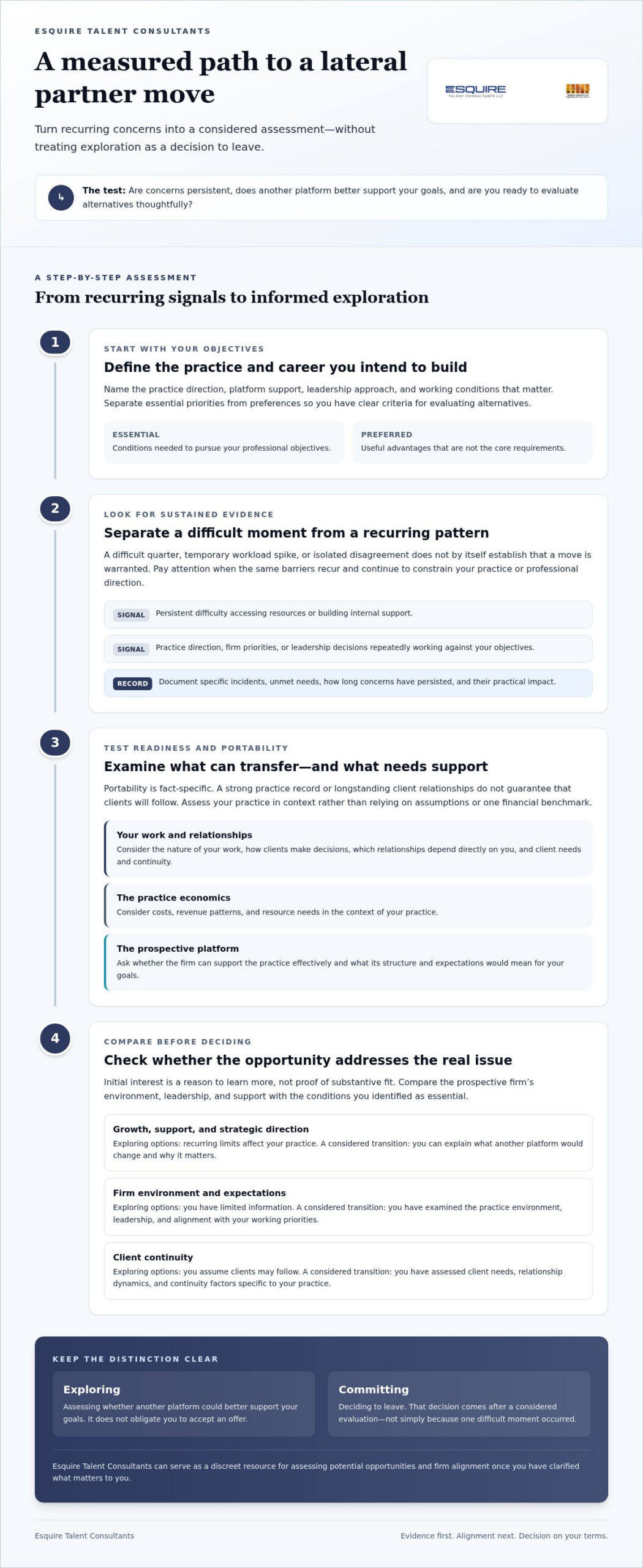
How to Explore a Lateral Partner Move Without Rushing the Decision
Once you have a reason to assess alternatives, a structured process can turn uncertainty into useful information without forcing a premature choice. Asking when to make a lateral partner move is different from deciding to resign; exploration can clarify whether a stronger professional fit exists while leaving the final decision open.
- Define your objectives. Identify the practice direction, platform support, leadership approach, and working conditions that matter most. Separate essential priorities from preferences.
- Assess current conditions. Describe what is working, what is constraining your practice, and whether those concerns are persistent. Be specific about what a better environment would change.
- Establish evaluation criteria. Decide how you will compare potential firms, including practice prospects, relationships, resources, and alignment with your longer-term aims.
- Consider selected conversations. After clarifying your priorities, determine whether a limited, purposeful discussion could help you test your assumptions and understand potential alternatives.
What should a partner clarify before exploring?
Set out your desired practice direction, the platform needs that would help support it, and the leadership expectations that matter to you. Record non-negotiable considerations alongside areas where you could be flexible. A clear account of your current concerns helps distinguish what you hope to leave behind from what you are seeking to build. Esquire Talent Consultants can help partners frame these priorities as they assess potential lateral opportunities.
How can market conversations inform the decision?
Discreet, selected conversations can help you understand a prospective firm’s priorities and assess whether its environment aligns with your objectives; they are not a promise of an offer or an obligation to proceed. For broader context, Esquire Talent Consultants discusses lateral partner recruitment trends and how market conditions may inform an evaluation. Throughout exploration, be deliberate about what you share, with whom, and when. Discretion is a consideration to manage thoughtfully, not a guarantee to assume.
When your objectives are clear, discuss a considered partner search with Esquire Talent Consultants as a potential next step.
Choosing a Strategic Partner for Your Lateral Move
Once you have defined your objectives and assessed your readiness, a specialist in attorney placement can help bring structure to the next stage of consideration. Esquire Talent Consultants focuses on attorney and partner-level placement, connecting partner talent with law firms across the United States. For partners weighing when to make a lateral partner move, this perspective can help focus attention on whether a prospective opportunity aligns with the practice and career they intend to build, rather than on the mere availability of an opening.
What should the placement strategy help clarify?
A considered strategy connects your stated objectives with the prospective firm’s environment and practice direction. That means examining whether the platform appears suited to your practice, whether its priorities correspond with your goals, and where further discussion may be needed to understand the fit. Esquire Talent Consultants supports individual partner lateral placement with this alignment in view, without treating interest as a promised outcome or assuming that every opportunity merits pursuit. For broader context, explore elite attorney placement services.
What is a measured next step?
An initial discussion can center on your priorities, the circumstances prompting consideration, and whether exploring potential opportunities is appropriate for your goals. It need not signal a decision to leave; it can help you bring greater definition to the questions that remain and the alignment you would seek in a new platform.
If you are ready to discuss your objectives and a potential partner search, speak with Esquire Talent Consultants. The conversation can be an informed next step, with the decision to move remaining yours.
Make Your Next Step Deliberate
A career transition does not need to begin with a final decision. It can begin with a clear question: what would need to be true for a new platform to represent a stronger long-term fit? Considering when to make a lateral partner move means giving that question the attention it deserves, then allowing evidence and considered discussion to shape your direction.
If your objectives are defined and you are ready to assess potential opportunities, Esquire Talent Consultants can help you consider a partner-level search with care. An initial conversation can focus on your priorities and the professional environment you hope to find, without presuming that you must leave your current firm.
Discuss your partner-level goals with Esquire Talent Consultants, and take the next step with clarity and confidence.
Frequently Asked Questions
Is there a best time of year to make a lateral partner move?
There is no universally best time of year; the right timing depends more on your readiness and the circumstances of your practice than on a particular season. For example, a partner may begin exploring after a change in firm leadership or a shift in practice priorities, provided there is room to evaluate options carefully. Consider whether you can give the process sustained attention and make decisions without unnecessary pressure.
Can a partner explore a lateral move without deciding to leave?
Yes. Exploration can help you understand what other firms may offer while you remain undecided about moving. You might use an initial conversation to clarify whether a prospective firm’s practice mix or leadership approach addresses a priority you have identified. Esquire Talent Consultants focuses on attorney and partner-level placement, and a discussion can help frame potential opportunities without requiring you to accept one.
Is it too late in a legal career to make a lateral partner move?
Not necessarily; career stage alone does not determine whether a move is worthwhile. Consider how a potential transition fits your remaining professional ambitions, the direction of your practice, and the role you want to hold in a new firm. A partner seeking to expand a mature practice may assess opportunities differently from one preparing to change focus, so clarify what a successful next chapter would mean to you.
Should a partner wait until receiving an offer before considering a move?
No. Waiting for an offer before defining your priorities can leave you evaluating an opportunity without clear criteria. Consider what you want to preserve, what you hope to change, and what information you would need to make a sound decision. That preparation can make later discussions more purposeful, whether they lead to further consideration or confirm that staying is the better choice.
How can a partner protect discretion while considering a lateral move?
Be intentional about the information you share and the people involved in early discussions. Avoid raising the subject casually in professional settings, and decide in advance which details about your practice or clients are appropriate to discuss at each stage. Discretion cannot be assumed, so handle sensitive information thoughtfully. Esquire Talent Consultants can provide a focused setting to discuss partner-level placement considerations.