
A law firm merger announcement tells you which firms plan to combine, but not what the change will mean for their attorney teams. Recruitment priorities depend on decisions that follow: which practices the firm intends to develop, where existing capabilities fit, and whether its structure creates a need for new talent. That is where law firm merger and acquisition recruitment becomes a strategic consideration, distinct from the deal itself.
To assess those priorities, look beyond the transaction’s scale and consider the firms’ stated plans, the practices involved, and how leadership expects the combined organization to operate. An announcement alone will not show which roles may need strengthening, how a partner or practice-group move could fit, or where the firm should focus its retention efforts.
This article explains how merger and acquisition activity can shape attorney and partner recruitment, and what firms can consider before and during a transition. Esquire Talent Consultants supports individual lateral placements, partner-group transitions, and law firm expansion and mergers. Its attorney-placement focus helps firms connect recruitment objectives to the organization they intend to build.
Key Takeaways
- Separate recruitment planning from transaction advice by identifying attorney and partner talent needs tied to firm growth or structural change.
- Compare the firm’s stated plans with its current practice capabilities to identify recruitment questions for 2026.
- Consider timing and confidentiality when assessing how to preserve key professional relationships while addressing changing talent needs.
- Define the placement objective and target profile before engaging support. Esquire Talent Consultants focuses on attorney and partner-level transitions.
What Law Firm Merger and Acquisition Recruitment Means for Attorney Talent
A merger announcement can describe the firms coming together without showing how their people and practices will fit. The recruitment question is more specific: which attorneys, partners, or partner groups could support the firm’s stated direction as its structure or priorities change? Law firm merger and acquisition recruitment is the planning and placement of attorney talent in connection with firm expansion, a merger, or an acquisition.
How recruitment differs from merger and acquisition advice
Transaction advice concerns the deal itself, including its structure and financial considerations. Recruitment concerns attorney and partner placement. They are distinct areas of work, even when they contribute to the same broader planning process. A firm can assess talent needs alongside transaction planning without treating recruitment as legal, financial, or transaction advice.
For general background on the terminology, Mergers and Acquisitions (M&A) describes the broader concepts. In a law firm context, the announcement alone does not specify which capabilities the combined organization may need, whether a practice would benefit from additional depth, or how individual partner opportunities may change. Those questions call for a separate assessment of professional needs and fit.
Which legal professionals are central to this discussion?
The focus is on attorneys, individual partners, and partner groups whose practices may align with a firm’s expansion plans or evolving priorities. For example, a firm considering a new capability can compare its current attorney bench with the experience that objective calls for. If a partner group is under consideration, leadership can assess how the group’s practice relates to the firm’s intended structure. These are recruitment questions to define, not assumptions about a particular opening.
Esquire Talent Consultants focuses exclusively on attorney and partner-level placements, including individual lateral moves and partner-group transitions. The firm supports talent placement, not advice on transaction terms. This distinction helps separate the mechanics of a deal from recruitment decisions about the legal professionals who may contribute to the organization taking shape.
Which 2026 Law Firm M&A Signals Can Reshape Recruitment Priorities?
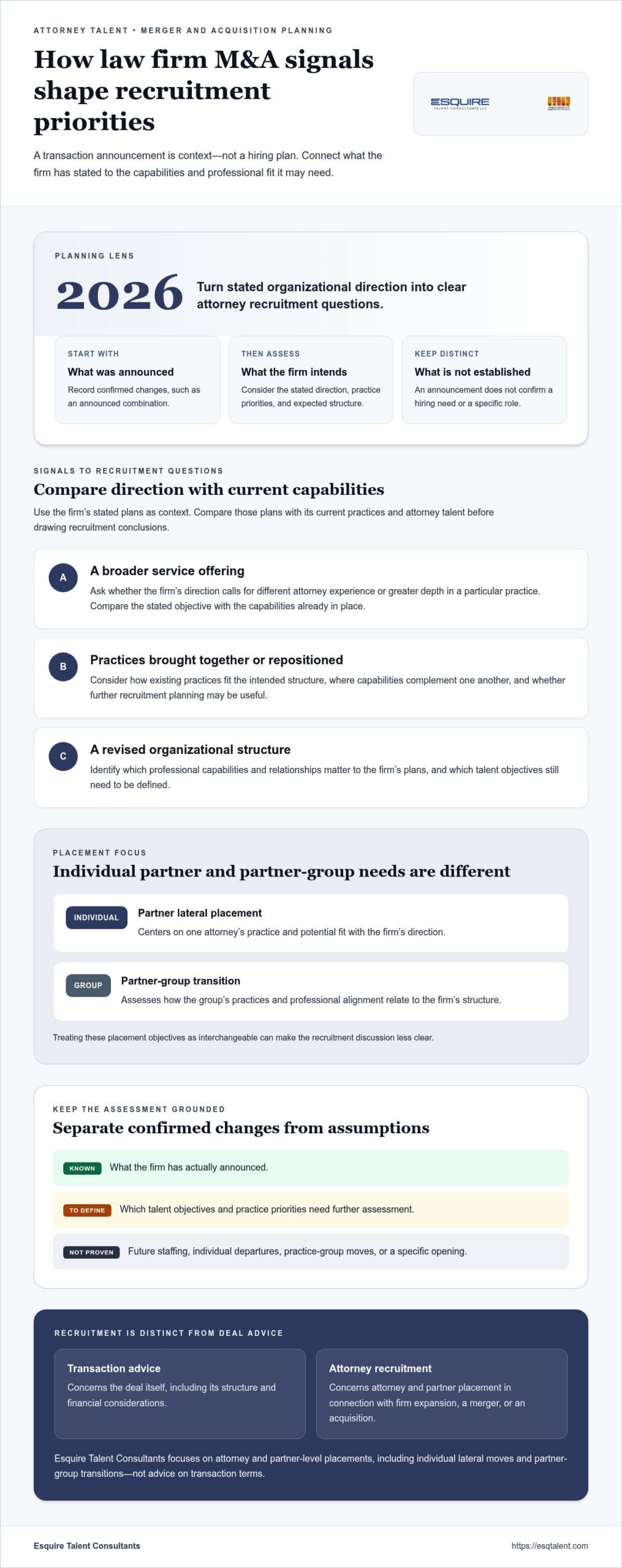
A transaction announcement can signal a change in strategic direction, but it does not establish that a firm intends to hire. For law firm merger and acquisition recruitment, the practical task is to connect stated organizational changes to questions about attorney capabilities, partner alignment, and practice priorities. Treat public commentary as context, not as a hiring plan.
From transaction announcements to attorney recruitment questions
When a firm announces expansion, a merger, or a revised structure, leadership can compare the stated direction with its current practices and talent. Does the plan describe a broader service offering? Are practices being brought together or repositioned? Does the firm’s stated direction call for different attorney experience or greater depth in a particular practice? Answering these questions helps identify where further recruitment planning may be useful without treating a possible need as a confirmed role.
Transaction signals can inform recruitment questions, but they do not prove that a firm has a hiring need or intends to recruit particular attorneys. Keep confirmed changes, such as an announced combination, separate from assumptions about future staffing, individual departures, or practice-group moves. This makes the recruitment discussion more useful: leadership can identify what is known, what remains undecided, and which talent objectives need to be defined.
Why partner and practice-group needs merit separate attention
An individual partner lateral placement centers on one attorney’s practice and potential fit with a firm’s direction. A partner-group transition involves assessing how a group’s practices and professional alignment relate to the firm’s structure. Treating these as interchangeable can make the placement objective less clear. Esquire Talent Consultants supports both individual partner moves and partner-group placement, with a focus on attorney recruitment.
When assessing a particular signal, document what has actually been announced, then identify the talent questions it raises. Avoid presenting speculation as fact or treating a transaction announcement as evidence of a specific opening. Esquire Talent Consultants supports firms considering attorney and partner placement alongside broader planning. For related perspective, explore lateral partner recruitment trends.
How Can Firms Balance Talent Continuity and Change During a Transaction?
A firm in transition must consider two priorities together: preserving professional relationships and responding to the organization’s evolving direction. Continuity does not require keeping every structure unchanged. It starts with understanding which relationships and practice strengths matter to the firm’s plans, then assessing whether deliberate attorney recruitment may address a changed need.
What talent continuity means in a law firm transition
Continuity planning begins with a clear view of how partners work together, how practices complement one another, and where priorities may shift as the firm takes shape. Leadership can identify the relationships and capabilities it aims to preserve, then compare them with the firm’s future priorities. Continuity planning connects the professional relationships a firm values with deliberate attorney recruitment aligned to its evolving priorities.
Timing and confidentiality deserve careful attention, particularly when recruitment conversations intersect with a broader transaction. Firms can consider what information is shared, with whom, and at what stage, while keeping recruitment planning distinct from legal or transaction advice. Esquire Talent Consultants focuses on attorney and partner-level placement, supporting firms as they consider talent in the context of change.
When an individual move and a group move call for different thinking
An individual partner transition centers on one professional’s practice, experience, and potential alignment with a firm. A partner-group transition calls for broader consideration of how several partners’ practices and working relationships may fit together. Neither route is inherently preferable. The right assessment depends on the firm’s objectives and the talent involved. Esquire Talent Consultants supports both individual lateral placements and partner-group transitions.
For partner-level recruitment, first define the scope of the potential move rather than assuming an individual and a group transition require the same approach. To discuss attorney and partner placement in the context of a firm transition, connect with Esquire Talent Consultants.
Where Specialized Recruitment Fits in Law Firm M&A Planning
Specialized recruitment can complement a firm’s broader merger or expansion planning by giving attorney talent its own defined workstream. Instead of treating a transaction announcement as a hiring brief, leadership can connect the firm’s stated direction to clear recruitment objectives, then decide whether placement support fits those objectives.
What a focused attorney recruitment discussion can establish
A focused discussion can clarify the talent need and the profile the firm is seeking. Esquire Talent Consultants specializes in attorney and partner-level placement, supporting individual partner moves, partner-group placement, and law firm expansion and mergers.
- Clarify the objective. Identify the practice or organizational priority the firm intends to address through recruitment.
- Define the profile. Specify whether the need concerns an individual attorney, an individual partner, or a partner group, then describe the relevant experience and practice alignment.
- Consider placement support. With the objective and profile defined, assess whether specialist recruitment support fits the firm’s plans.
This sequence connects talent planning to the firm’s stated direction without confusing attorney placement with legal, financial, or transaction advice. It also gives Esquire Talent Consultants a clear understanding of the placement objective and the scope of the search.
How to continue evaluating partner-level search approaches
Partner recruitment calls for attention to both professional fit and the firm’s intended structure. An individual lateral move and a partner-group transition involve different placement scopes, so defining the need first helps leadership consider an approach that reflects its objectives. Esquire Talent Consultants supports both types of partner-level placement, as well as attorney recruitment connected to firm growth.
For firms assessing how specialized recruitment may support a transition, a focused conversation can bring the talent objective into clearer view. Discuss your attorney recruitment priorities with Esquire Talent Consultants as part of your broader planning.
Set a Clear Talent Direction for What Comes Next
A firm’s next chapter takes shape through deliberate decisions about the people and practices that will support its direction. Treating recruitment as part of transition planning can help leadership move from broad ambition to a defined understanding of the attorney talent it seeks, while keeping personnel decisions distinct from the transaction itself. That gives law firm merger and acquisition recruitment a purpose beyond responding to announcements: it connects talent choices to the organization the firm intends to build.
Start by identifying the recruitment priorities that matter to your firm, including the experience and professional alignment sought. Esquire Talent Consultants brings a focused placement perspective to individual attorney and partner moves, partner-group transitions, and firm expansion and mergers.
Discuss your firm’s attorney recruitment priorities with Esquire Talent Consultants and define a clear next step.
Frequently Asked Questions
How does a law firm merger affect attorney recruitment?
A merger can change which attorney skills a firm needs by combining practices, creating new priorities, or revealing a gap between existing experience and future plans. For example, leadership may compare its current attorney bench with the depth needed for a practice the combined firm intends to develop. Law firm merger and acquisition recruitment helps turn those priorities into specific attorney or partner profiles, rather than assuming the transaction itself determines who should be hired.
When should a law firm consider recruitment during a merger or acquisition?
A firm can begin assessing recruitment when its strategic direction and likely practice priorities are clear enough to identify potential talent needs. Early assessment gives leadership time to distinguish a defined need from a possibility and to describe the experience sought. The assessment can be revisited as plans develop, keeping recruitment aligned with the firm’s direction rather than driven only by transaction timing.
Can a law firm recruit a partner group as part of an acquisition strategy?
Yes. Esquire Talent Consultants supports partner-group placement, which can fit a recruitment objective focused on a group of partners rather than one individual. The placement discussion can consider the group’s practice profile and how it relates to the firm’s priorities. Placement support is distinct from executing or advising on an acquisition. Whether an individual or group approach fits depends on the firm’s talent objective.
What does a legal recruiter do in a law firm merger?
A legal recruiter supports attorney and partner placement by helping a firm define the professional profile it seeks. For example, leadership might identify a need for a partner whose experience aligns with a developing practice, then use that profile to guide recruitment. Esquire Talent Consultants specializes in attorney and partner-level placements. Its role is talent placement, not legal, financial, or transaction advice.