
What makes a legal talent consultancy useful is not simply the introduction of candidates. It is the ability to frame an attorney placement around the firm’s priorities and the lawyer’s professional direction. Before beginning a search, clarify the role’s purpose, the experience it calls for, and how the hire fits the firm’s plans. Esquire Talent Consultants focuses exclusively on attorney and partner-level placements, including individual lateral moves and partner-group transitions.
A consultancy differs from general staffing because its scope is focused on particular hiring needs. For firms, that can mean defining the experience, seniority, and practice needs behind an attorney search. For lawyers, it can mean weighing the work, responsibility, and firm context involved in a potential move. This guide explains how a legal talent consultancy can support attorney and partner-level placements, what to consider before a search, and how individual moves, partner-group placements, firm expansion, and mergers relate to talent decisions. Esquire Talent Consultants works with firms and attorneys on these placement objectives.
Key Takeaways
- Distinguish a legal talent consultancy from general staffing by considering whether your hiring or career decision calls for a focus on attorney placements.
- Define the objective first, then identify the seniority, practice needs, firm context, and candidate priorities that should shape the search.
- Consider placement support before a vacancy is fully defined, particularly when assessing a lateral move or a broader expansion plan.
- Esquire Talent Consultants focuses on attorney and partner-level placements, including individual lateral moves and partner-group transitions.
Legal Talent Consultancy vs. General Staffing
When a law firm needs to add legal talent, start by identifying the hiring challenge. Filling a defined attorney role, considering a partner’s lateral move, and planning for firm growth each involve different priorities. A legal talent consultancy focuses on attorney placements and connects the search with the firm’s objectives and the considerations that shape a candidate’s decision.
General staffing and specialist placement serve different purposes. Broad staffing can address workforce needs across roles and sectors. An attorney-focused consultancy concentrates on lawyer and partner placements, where seniority, practice needs, and the role’s place in the firm’s plans help define the search. The distinction is scope, not a claim that one approach fits every hiring need. Esquire Talent Consultants specializes in attorney and partner-level placements.
What makes attorney placement a specialized discipline?
An attorney role involves more than a job title. A useful search brief identifies the practice experience needed, the level of responsibility, the firm context, and the contribution expected from the hire. A partner search can raise different considerations from an individual attorney placement, while a partner-group move adds questions about shared priorities and organizational fit. Defining these distinctions helps make the search more precise.
“Legal talent” can refer to different professional groups, but their hiring needs are not interchangeable. Esquire Talent Consultants focuses exclusively on attorney and partner-level placements, including individual lateral placements and partner-group moves. This focus is relevant when the decision concerns an attorney’s career, a partner transition, or the role a placement plays in a firm’s plans. For a more useful starting brief, specify the type of placement, the experience required, and the business or career objective behind it.
How Does a Legal Talent Consultancy Connect Hiring Goals with Attorney Searches?
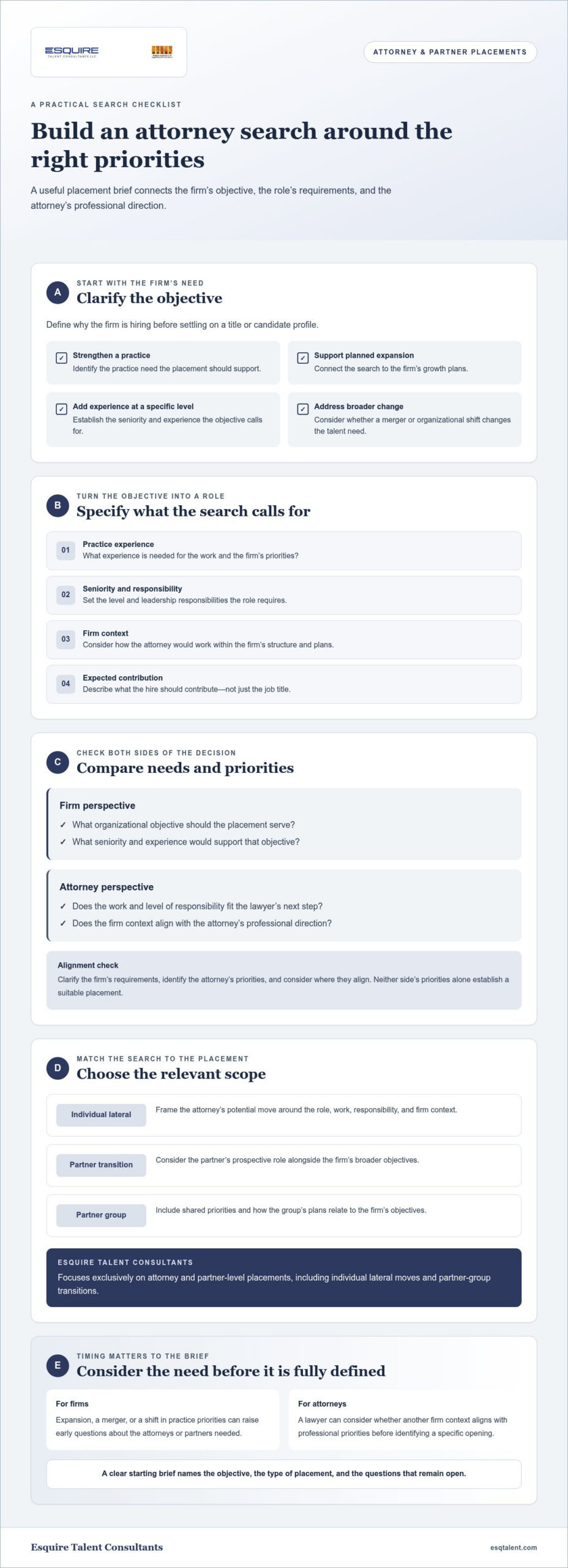
A search is easier to define when the firm can explain why it is hiring. Is the objective to strengthen a practice, support planned expansion, or add experience at a particular level? Those answers help clarify which attorney profiles are relevant and what the role should contribute. Without them, a search can be too narrow, focused only on a title, or too broad to separate essential qualifications from preferences.
Where strategy enters an attorney search
Once the business need is clear, use it to identify the experience, seniority, and leadership responsibilities the role calls for. Also consider how the attorney would work within the firm’s structure and priorities. For a lateral partner search, assess the partner’s prospective role alongside the firm’s broader objectives. Esquire Talent Consultants focuses on attorney and partner-level placements, where these considerations help frame the placement discussion.
Alignment also depends on the candidate’s perspective. An attorney may weigh the work, level of responsibility, professional direction, and fit with the firm’s context. A search that considers only the vacancy can overlook whether the opportunity suits the lawyer being approached. On the other hand, a candidate’s preferences alone do not establish whether the move meets the firm’s need. Compare both sides: clarify the firm’s requirements, identify the attorney’s priorities, and consider where they align.
Esquire Talent Consultants handles individual lateral placements and partner transitions with this attorney- and partner-level focus. For firm expansion or mergers, first distinguish whether the need is for an individual hire, a partner group, or a broader placement objective. Firms can discuss an attorney placement objective with Esquire Talent Consultants, using the business need and role context as a starting point.
When Can a Legal Talent Consultancy Help Firms and Attorneys?
Firms can consider their talent needs before a vacancy is finalized. Expansion, a merger, or a shift in practice priorities may raise early questions about the attorneys or partners needed to support the firm’s direction. An attorney can also weigh a lateral move before identifying a specific opening, by considering whether a different firm context aligns with their professional priorities. In either case, an early discussion can help define the objective, the type of placement under consideration, and the questions that remain open.
The firm’s organizational objectives and the attorney’s career considerations are distinct. Clarifying both helps determine whether a potential move makes sense.
| Perspective | Questions to clarify |
|---|---|
| Firm | Is the priority expansion, a practice need, or a broader organizational change? What seniority and experience would serve that objective? |
| Attorney | What kind of work, responsibility, and firm environment fit the lawyer’s next career step? What would make a transition worthwhile? |
What changes when a search involves a partner group?
A partner-group move involves several professionals, so the discussion extends beyond individual career interests. It also considers shared priorities and how the group’s plans relate to a firm’s objectives. Esquire Talent Consultants provides partner-group placements as well as individual attorney transitions. For firms considering strategic lateral partner hiring, clarifying the organizational aim and the group’s priorities gives the search a more useful starting point. Readers exploring elite attorney placement services can also consider how the scope of a search relates to the placement objective.
A legal talent consultancy can be involved before a vacancy is formally defined, especially when a firm is assessing growth or an attorney is considering a move. Esquire Talent Consultants supports attorney and partner-level placement discussions, including individual and group transitions. Discuss a firm or attorney placement objective with Esquire Talent Consultants.
What Should You Expect from an Attorney-Focused Legal Talent Consultancy?
An attorney-focused legal talent consultancy brings a defined professional focus to a hiring or career decision. Esquire Talent Consultants concentrates exclusively on attorney and partner-level placements, including lateral attorney searches, partner transitions, and partner-group moves. This focus serves firms considering an attorney placement and lawyers weighing whether a potential change fits their career direction.
How Esquire Talent Consultants approaches specialist placement
A useful placement discussion starts with the type of move and what it needs to accomplish. For an individual lateral hire, define the role, required experience, and fit with the firm’s objectives. For a partner or partner group, include the scope of the transition, shared priorities where relevant, and the firm context. In a partner discussion, compensation can be one consideration alongside role scope, practice needs, and the circumstances of a potential move. These factors can help frame the discussion, but do not guarantee a particular placement outcome.
Which conversations fit an attorney-placement specialist?
Law firms can discuss a defined attorney search or consider how a lateral move might support wider plans. Partner-group discussions bring multiple professionals and shared considerations into view. Attorneys can explore whether a potential transition aligns with their preferred work, responsibilities, and professional direction. Esquire Talent Consultants focuses on these attorney and partner-level conversations, including individual lateral placements and partner-group placements.
To prepare for an initial discussion, identify the firm’s hiring objective, the type of placement under consideration, or the career questions behind an attorney’s potential move. Esquire Talent Consultants also works on attorney placements in firm expansion and merger contexts. Firms considering a search and attorneys weighing a lateral transition can discuss their objectives with Esquire Talent Consultants.
Set Your Next Talent Decision in Motion
A considered talent decision begins with clarity about what should change and what should remain central to the firm’s or attorney’s direction. Before a conversation, write down the opportunity you hope to create, the responsibilities involved, and the professional priorities that should guide a potential move. For firms, a clear brief should distinguish required experience from preferences. For attorneys, it helps to identify what a new role would need to offer to merit a transition.
A legal talent consultancy brings professional context to a consequential placement decision. For firms and lawyers alike, a focused discussion can help clarify whether an attorney placement is the right next step and which considerations should guide the search. Esquire Talent Consultants works exclusively on attorney and partner-level placements, including lateral moves and partner-group transitions.
Start with one clear objective: begin a conversation about attorney placement with Esquire Talent Consultants.
Frequently Asked Questions
Can an attorney speak with a legal talent consultancy before deciding to move?
Yes. An exploratory conversation does not commit an attorney to changing firms or pursuing an opportunity. It can help clarify priorities such as preferred practice, responsibilities, and firm environment, and whether a transition merits further thought. The attorney decides whether to explore a particular opportunity or take any next step.
Does a legal talent consultancy only work with law firms?
No. A placement discussion can involve a firm seeking attorneys or a lawyer considering a career transition. Esquire Talent Consultants focuses on attorney and partner-level placements, so a conversation may center on a firm’s hiring objectives or an individual’s professional priorities. An attorney, for example, can clarify what they hope to change before deciding whether to consider a specific move.
Does every partner-group move involve the same number of attorneys?
No. A partner-group transition is not a fixed-size package; its scope depends on the professionals involved and the circumstances of a potential move. The group’s shared priorities and the receiving firm’s objectives may shape the discussion. Esquire Talent Consultants provides partner-group placement services, with the relevant considerations determined by the particular situation rather than a standard group size.
Is a legal talent consultancy the same as an in-house recruiting team?
Not necessarily. An in-house team operates within a firm’s own hiring structure, while an external consultancy can bring a specialist focus to attorney placement. The approaches can address different needs and may complement one another. A firm might use internal recruiters for ongoing hiring while engaging an attorney-placement specialist for a senior search.