
What if a partner’s impressive portable-work projection does not translate into a durable client transition? Effective law firm lateral partner vetting looks beyond headline numbers to examine the assumptions behind them, including the candidate’s strategic fit, the nature of key client relationships, and what can be appropriately confirmed.
That distinction matters. Decision-makers need credible evidence, but a thorough review must also preserve discretion and candidate trust. A structured process helps your firm identify what is supported, where important gaps remain, and which transition questions need closer attention before a hiring decision.
This article offers a repeatable checklist for assessing practice alignment, business history, client relationships, conflicts, and integration considerations. It also explains how to sequence sensitive discussions and verify information through appropriate, authorized channels. Involve qualified counsel when legal, ethical, conflicts, or confidentiality questions arise.
Esquire Talent Consultants specializes in attorney and partner-level placements, including individual lateral moves and partner groups. For firms evaluating a partner-level search, its specialized placement perspective can help frame the opportunity and the practical considerations involved in a potential transition.
Key Takeaways
- Start law firm lateral partner vetting with a clear hiring rationale, then assess the candidate’s potential contribution against the firm’s stated priorities.
- Organize the review around strategic fit, practice contribution, client relationships, and transition readiness. Separate supported information from candidate statements and open questions.
- Use a discreet, sequenced process to gather authorized information, address evidence gaps, and document the basis for each decision.
- Compare findings with the original hiring mandate and clarify integration assumptions. Esquire Talent Consultants brings a partner-level placement perspective to lateral searches.
What Law Firm Lateral Partner Vetting Should Establish Before Interviews Advance
Law firm lateral partner vetting is an evidence-informed assessment of a candidate’s strategic fit, supporting information, and transition assumptions before a firm makes a hiring decision. It gives decision-makers a disciplined way to consider both the opportunity and the uncertainties, rather than treating a strong first impression as evidence of future performance. As part of the broader due diligence process, the goal is to examine relevant information carefully before entering an agreement.
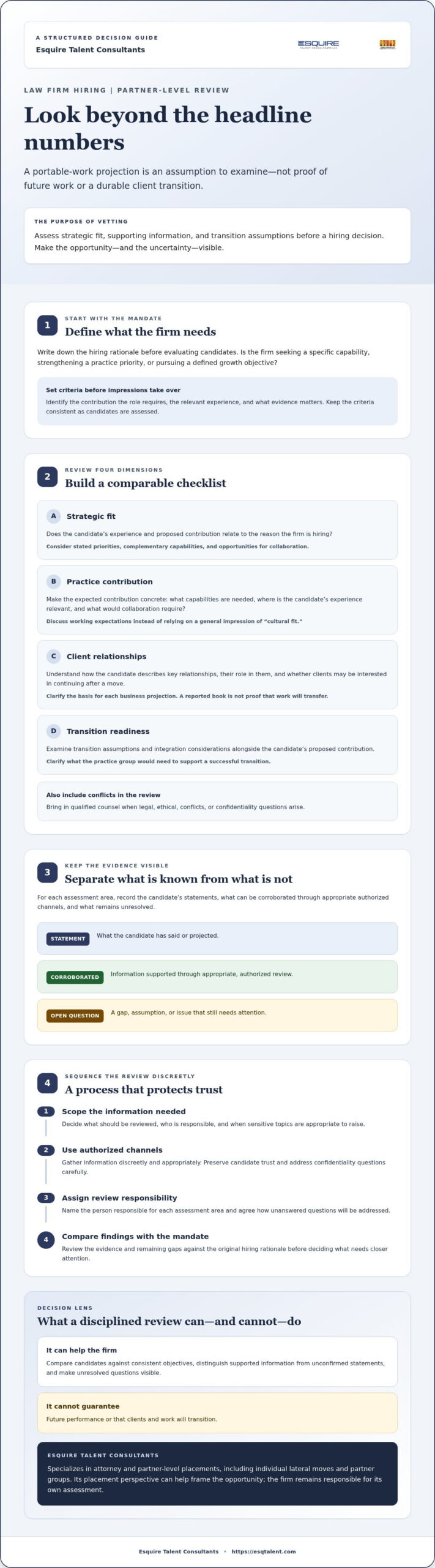
Start by writing down the hiring rationale. Is the firm seeking a specific capability, aiming to strengthen a practice priority, or pursuing a defined growth objective? If the mandate is to build a particular practice, assess how the candidate’s experience and proposed contribution relate to that goal. Record the criteria before evaluating candidates so the review does not shift with individual impressions.
Initial conversations can establish mutual interest. Formal diligence should have a deliberate scope and sequence: identify what information is needed, who should review it, and when sensitive topics are appropriate to raise. Gather information only through authorized channels. Esquire Talent Consultants brings a partner-level placement perspective to these decisions, while the firm remains responsible for its own assessment.
What is the purpose of lateral partner due diligence?
A consistent process lets decision-makers compare candidates against the same objectives and relevant criteria. It helps separate information supported by appropriate review from statements that have not been independently confirmed, and it makes unresolved questions visible before a decision. Vetting can inform a hiring decision, but it cannot guarantee future performance or client transitions.
Who should shape the assessment criteria?
The right participants depend on the firm’s decision process. Relevant decision-makers and practice leaders can define what the hire must contribute and what evidence matters. Involve other stakeholders when their perspective is relevant to the role or transition. For each assessment area, name the person responsible for reviewing it and agree how unanswered questions will be addressed. Esquire Talent Consultants focuses exclusively on attorney and partner-level placements, offering a specialized search perspective for firms considering individual lateral moves and partner groups.
Which Areas Should a Law Firm Lateral Partner Vetting Checklist Cover?
A useful law firm lateral partner vetting checklist turns the hiring mandate into comparable areas of inquiry: strategic fit, practice contribution, client relationships, and transition readiness. For each area, record what the candidate has said, what the firm can corroborate through appropriate, authorized channels, and what remains unresolved. First Advantage’s discussion of inadequate due diligence underscores why impressions alone should not replace a consistent review.
How should firms assess practice and strategic fit?
Compare the candidate’s experience and proposed contribution with the reason the firm is hiring. Consider whether the practice complements existing capabilities, supports stated priorities, and presents credible opportunities for collaboration. Make this assessment concrete: identify which capabilities the firm needs, where the candidate’s experience is relevant, and what collaboration would require from the practice group.
Explore working expectations rather than relying on a general impression of “cultural fit.” For example, discuss how the candidate approaches collaboration and what the practice group would need to support a successful transition. Treat compatibility as a set of specific questions, not a conclusion based on personal chemistry.
What should firms examine about client relationships and portability?
Ask how the candidate describes key client relationships, their role in those relationships, and whether clients may be interested in continuing the relationship after a move. Clarify the basis for any business projection and distinguish the candidate’s estimate from evidence that work will transfer. A reported book of business is an assumption to examine, not proof of future work.
Keep client and matter details appropriately limited. Do not request confidential information unnecessarily, and refer conflicts, confidentiality, and other legal or ethical questions to qualified counsel.
For consistent comparison, use a brief record for each criterion:
- Criterion: What the firm needs to assess.
- Evidence available: Candidate statements and authorized corroboration.
- Open question: What remains uncertain.
- Follow-up owner: Who will address the gap.
This format helps decision-makers distinguish evidence from expectation without overstating portability or fit. For firms considering an individual partner or partner-group placement, discussing partner-level search considerations with Esquire Talent Consultants may offer a relevant perspective.
How to Apply a Discreet Lateral Partner Vetting Checklist
A reliable process makes the review deliberate without making it indiscriminate. In law firm lateral partner vetting, move through clear stages: define the criteria, gather information through appropriate and authorized channels, assess it against the hiring mandate, resolve material gaps, and document the decision. Limit sensitive discussions to people who need to participate, and avoid requesting confidential client or matter details unnecessarily.
Label information consistently so decision-makers can see what is established and what still needs attention:
- Substantiated: Supported through appropriate corroboration.
- Candidate-reported: Provided by the candidate but not independently confirmed.
- Unresolved: Incomplete, inconsistent, or still awaiting follow-up.
- Requires qualified review: Raises a legal, ethical, conflicts, or confidentiality question for counsel.
How can firms validate information without overreaching?
Use suitable sources and reference discussions only when authorized and appropriate to the circumstances. If a practice history or business projection is unclear, ask a focused question about the basis for the estimate instead of seeking unnecessary client-identifying details. If an answer differs from available information, record the discrepancy neutrally and give the candidate an appropriate opportunity to clarify it. Refer sensitive issues to qualified counsel.
How can a firm keep the process consistent?
Apply the same core criteria to each candidate under consideration, then add role-specific questions tied to the practice need. A shared record should identify the information reviewed, outstanding questions, follow-up owner, and decision rationale. This reduces reliance on memory and shifting impressions while leaving room to assess each candidate’s distinct contribution.
Esquire Talent Consultants specializes in attorney and partner-level placements, including individual lateral moves and partner groups. If your firm is considering a partner-level search and would value a specialized placement perspective, contact Esquire Talent Consultants.
How to Interpret Vetting Findings and Decide on Next Steps
Interpret the findings against the hiring mandate established at the outset. A candidate may offer a strong practice fit while questions about client interest or transition timing remain unresolved. Keep those conclusions distinct: experience and practice needs may support role alignment, while future client movement or financial contribution may still rest on assumptions. Law firm lateral partner vetting should make clear both what the evidence supports and what the firm has yet to establish.
What should decision-makers document before reaching a conclusion?
Before deciding whether to proceed, pause, or decline, record the information reviewed, material open questions, and rationale for the next step. Note whether each conclusion is supported, candidate-reported, or uncertain. If market context informs the hiring rationale, compare it with a relevant law firm lateral partner market analysis, while keeping the firm’s own mandate central.
A concise decision record can distinguish:
- Strengths: Evidence that aligns with the role and practice priorities.
- Open questions: Matters requiring follow-up or qualified review.
- Transition assumptions: Expectations about integration, client interest, or contribution that are not yet established.
- Next step: The decision, its rationale, and any agreed follow-up.
A positive assessment is not a substitute for realistic integration planning. Before advancing, clarify mutual expectations about the candidate’s role, collaboration with the practice group, and transition priorities. Esquire Talent Consultants brings a specialized attorney and partner-level placement perspective to firms evaluating individual lateral moves or partner groups. Its national practice connects legal talent with law firms; firms considering strategic law firm partner recruitment may find that perspective useful as they assess their next step.
Make Your Next Partner Decision with Greater Clarity
Strong law firm lateral partner vetting connects the hiring mandate to evidence, open questions, and realistic transition assumptions. A consistent checklist helps decision-makers assess strategic fit and client relationships without treating projected work as certain. Documenting what is substantiated, what remains unresolved, and what requires further review makes the next step clearer.
Even a positive assessment is only part of the decision. Thoughtful integration planning and clear mutual expectations help firms and candidates approach a potential transition with a shared understanding of the opportunity.
Esquire Talent Consultants specializes exclusively in attorney and partner-level placements, supporting individual lateral partners and partner groups for law firm clients nationally across the United States. To discuss a strategic partner search, connect with Esquire Talent Consultants. A deliberate process can help your firm move forward with confidence and care.
Frequently Asked Questions
What does law firm lateral partner vetting involve?
Law firm lateral partner vetting is a structured review of how a prospective partner aligns with the firm’s hiring objectives. It considers relevant experience, potential practice contribution, client relationships, and transition assumptions, with criteria tailored to the role. Decision-makers should distinguish candidate-reported information from details appropriately confirmed through authorized channels. The process can inform a hiring decision, but it cannot guarantee future performance or client movement.
How do firms assess whether a lateral partner’s book of business is portable?
Firms can examine how the candidate describes client relationships, potential interest in continuing those relationships, and the basis for business projections. Identify what can be appropriately validated without treating a reported book as a promise of future work. Handle questions involving clients, matters, conflicts, or confidentiality with suitable professional review, including consultation with qualified counsel where appropriate.
What should a law firm include in a lateral partner vetting checklist?
A practical checklist should connect the hiring rationale to practice and strategic fit, relevant experience, client-relationship considerations, available supporting information, unresolved questions, and transition readiness. For each item, record whether it is candidate-reported, supported by available information, or still open. Tailor the criteria to the position and firm priorities rather than applying an identical checklist to every search. Esquire Talent Consultants focuses on attorney and partner-level placements.
How can law firms vet a lateral partner while protecting confidentiality?
Limit sensitive discussions to appropriate participants, rely on authorized information sources, and avoid requesting confidential client or matter details unnecessarily. Before gathering information, clarify who needs access and how outstanding questions will be addressed. Confidentiality and related considerations can depend on the circumstances, so firms should consult qualified counsel rather than treating a general vetting checklist as legal advice. A carefully sequenced process can support diligence while respecting discretion.
When should a firm involve a lateral partner placement consultant?
A firm may consider specialized support when defining a partner search, managing discreet candidate conversations, or coordinating a potential transition. Esquire Talent Consultants specializes exclusively in attorney and partner-level placements, including individual lateral partners and partner groups, and serves law firm clients nationally across the United States. A placement consultant can contribute a specialized search perspective, while the firm retains responsibility for its assessment and hiring decision.